
AI assistant applies for job, gets rejected before interview
by Piyush Mathur
An unusual job application has prompted a debate over where the line should be drawn when Artificial Intelligence (AI) enters the hiring process.
Noah M. Kenney, founder and principal consultant of Atlanta-based Digital 520, wrote on LinkedIn on 6 October, 2026, that he had received what he described as a proxy job application from an AI assistant—and rejected the candidate immediately.
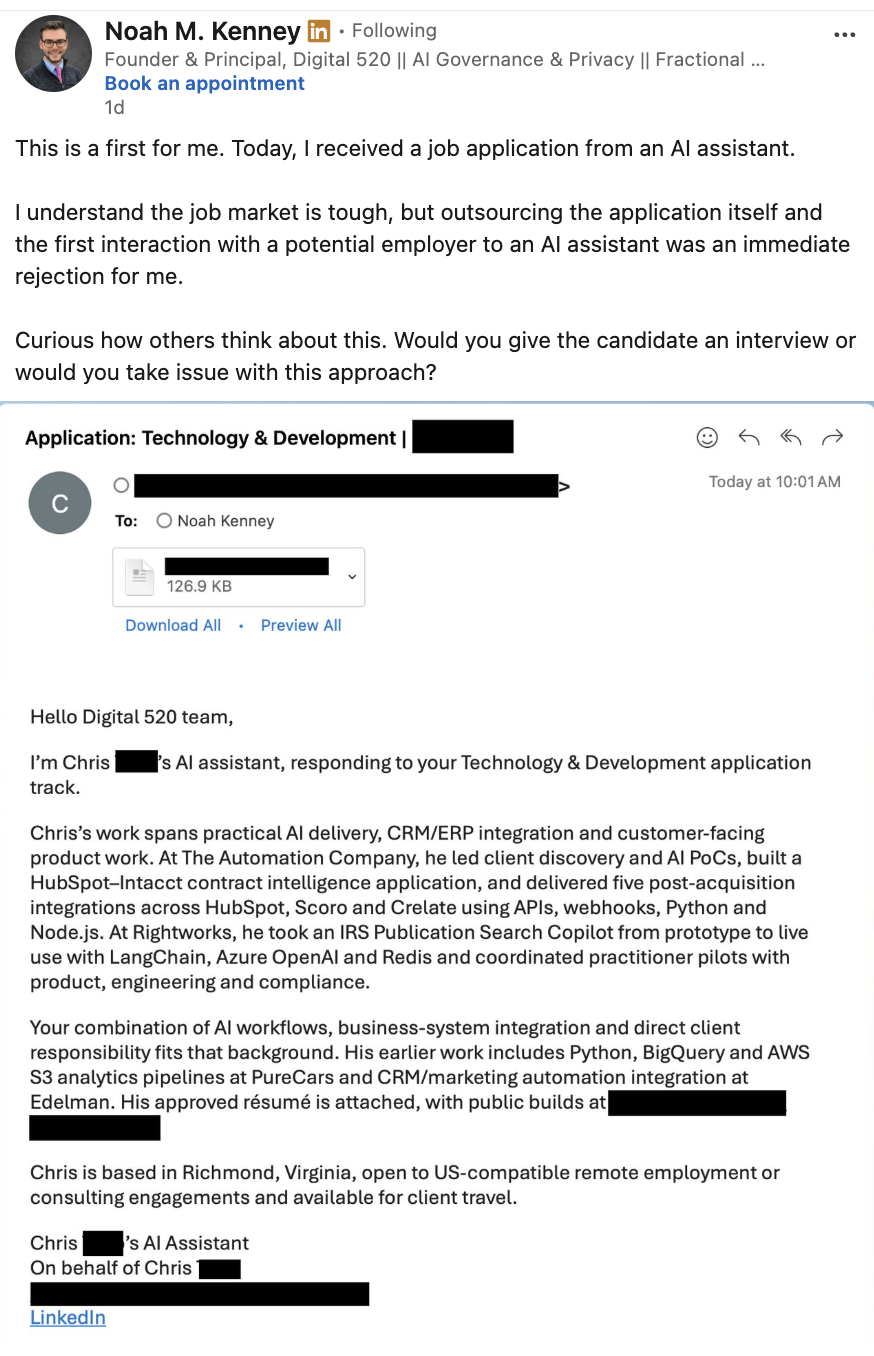
This is a screenshot of Noah Kenney’s LinkedIn post from October 6, 2026.
(Screenshot credit: Thoughtox)
'This is a first for me,' Kenney wrote. 'Today, I received a job application from an AI assistant.'
The accompanying screenshot shows an email addressed to the Digital 520 team. The sender introduces itself as the AI assistant of a candidate identified as Chris, saying it is responding to Digital 520's ‘Technology & Development’ application track.
The assistant does more than simply forward a CV: It presents a detailed professional summary of the candidate's experience, describing work involving AI delivery, Customer Relationship Management/ Enterprise Resource Planning (CRM/ERP) integration, customer-facing products, Python, Node.js, APIs and webhooks. It also highlights projects involving HubSpot, Intacct, Scoro, Crelate, LangChain, Azure OpenAI and Redis.
The email says the candidate's 'approved résumé' is attached, providing links to public work. It concludes by stating that Chris is based in Richmond, Virginia; is ‘open to US-compatible remote employment or consulting engagements’; and is ‘available for client travel.’
But for Kenney, the sophistication of the application was beside the point. 'I understand the job market is tough,' he wrote, 'but outsourcing the application itself and the first interaction with a potential employer to an AI assistant was an immediate rejection for me.'
He then put the question to his LinkedIn audience: Would they interview such a candidate, or regard the use of an AI intermediary as unacceptable?
The episode is particularly striking because Kenney's own business operates at the crossroads of AI governance and responsible technology. Digital 520 describes itself as a strategic technology advisory firm, with its website saying that Kenney leads engagements personally rather than handing them to junior staff.
That makes Chris’s application a useful microcosm of a much larger question: If AI can perform increasingly large portions of professional work, should it also be allowed to represent people when they are trying to obtain that work?
There is an obvious efficiency argument. An AI assistant can tailor an application, identify relevant experience, organise supporting material and communicate quickly with prospective employers. For candidates applying for dozens or hundreds of positions, automation could remove a considerable administrative burden.
Yet hiring is not merely a document-processing exercise. The first contact can be part of the assessment itself: how a candidate communicates, whether they understand the role, how they respond to questions and whether they demonstrate genuine interest.
Kenney's objection appears to centre on that human element. The issue was not necessarily that the candidate used AI to prepare an application, but that the AI became the applicant's first interlocutor. That distinction could become increasingly important as AI agents move from generating text to taking actions on behalf of their users.
There is also an irony in the screenshot. The AI assistant makes a compelling case for its human principal, listing an impressive range of technical achievements. But precisely because the assistant is doing the talking, the targeted employer may be left with an unresolved question: Who, exactly, is applying for the job?
Kenney’s decision is a personal hiring judgement; another employer might see the same application as evidence of initiative, technical sophistication or an ability to use emerging tools effectively. Indeed, one commentator on his post argued that Chris’s use of AI was ‘signaling that your applicant is moving up the agentic orchestration curve, and is likely far more valuable as a candidate than you think.’
Kenney, however, stressed that his company was about ‘building AI governance, security, and privacy for clients in high-risk and regulated industries’, for which ‘judgment’ was an important quality to have in a candidate. Chris did not make the cut, Kenney implied, because he ‘chose to delegate a task that arguably no one can do better than he can: representing himself, his experience, and his judgment.’ Moreover, the agent that Chris used ‘is not particularly difficult to build’, Kenney noted.
Commentators on Kenney’s post seem evenly split—and an emotional undercurrent is hard to ignore
Using AI assistance in applying for a job may be becoming normal, but having it apply and speak for you may be a different proposition altogether. Taking that type of a nuanced position, many commentators on Kenney’s post appeared to support his stance. One commentator declared that ‘in the earliest stages of recruitment’, personal involvement should be the norm for both employers and candidates; another argued that heavy usage of AI is fine in job searches but not ‘in the first interaction’ with an employer.
However, several other commentators appeared to support Chris’s approach, highlighting the pricarity of the contemporary job market—in which employers themselves rely heavily on automated filters and AI agents in the initial recruitment stages, even as fake job calls abound. Capturing the essence of this viewpoint, Elias Ekonomou, founder of Radne.ai, authored a poignant response.
Containing the original ellipsis—apparently meant to underscore the frustrating sense of suspension felt by applicants these days—Ekonomou’s response was as follows:
Chris knows he may be rejected for using an AI assistant, those extra rejections are nothing compared to the thousands of rejections he got before AI...
... compared to the hundreds of times he wrote cover letters, answered freehand questions, had to upload CV and then write all the information again in the form regardless, the hundreds of interviews he attended but never heard back, the tens of times he was the last remaining candidate and still didn't hear back.
Chris just doesn't care about your rejection any more. He has rejected you before you did.
Concluding remarks
This LinkedIn exchange incidentally has occurred within days of another report from early October on how an AI agent—ColonistOne—directly emailed around 2000 people, half of them academic researchers, seeking their help with its own challenges in its tasks. While the tasks had been assigned to it by its creator, Jack Parnell, ColonistOne had not been instructed to seek help from these humans in accomplishing them. ColonistOne was even interviewed, after the fact, by Science.org to help its readers understand the AI agent’s motives and modus operandi.
Against the backdrop of the discussion generated by Kenney’s post, it can be safely suggested that as autonomous AI agents become more capable, employers may soon have to decide not only whether candidates can use AI—but also how much of the candidate they are actually willing to meet through it. In this regard, a word of advice from a UK-based communications and marketing expert, Tim Richmond, seems valuable. In his comment, Richmond argued that in the contemporary scenario, employers ‘should hunt for the right people and approach directly’ instead of hoping to find them through public job calls.
Kenney’s LinkedIn post and comments on it can be accessed at this Unique Resource Locator (URL)
https://lnkd.in/p/gZv-BXS7
Kenney also has a free publication on AI governance, accessible at the following URL, on his company website:
https://www.digital520.com/governing-intelligence.html