
A huge draw, Figure AI’s humanoid labour livestream enters Day 3
by Piyush Mathur
What began as Figure AI’s eight-hour showcase of autonomous robots handling small packages on a conveyor belt has turned into a multi-day spectacle that has both captivated and bemused YouTube viewers. As Day 3 of the livestream rolls on, the demonstration has passed over 65 hours of continuous operation and, by current counts, the machines have apparently sorted more than 82 000 packages in the looped workflow so far.
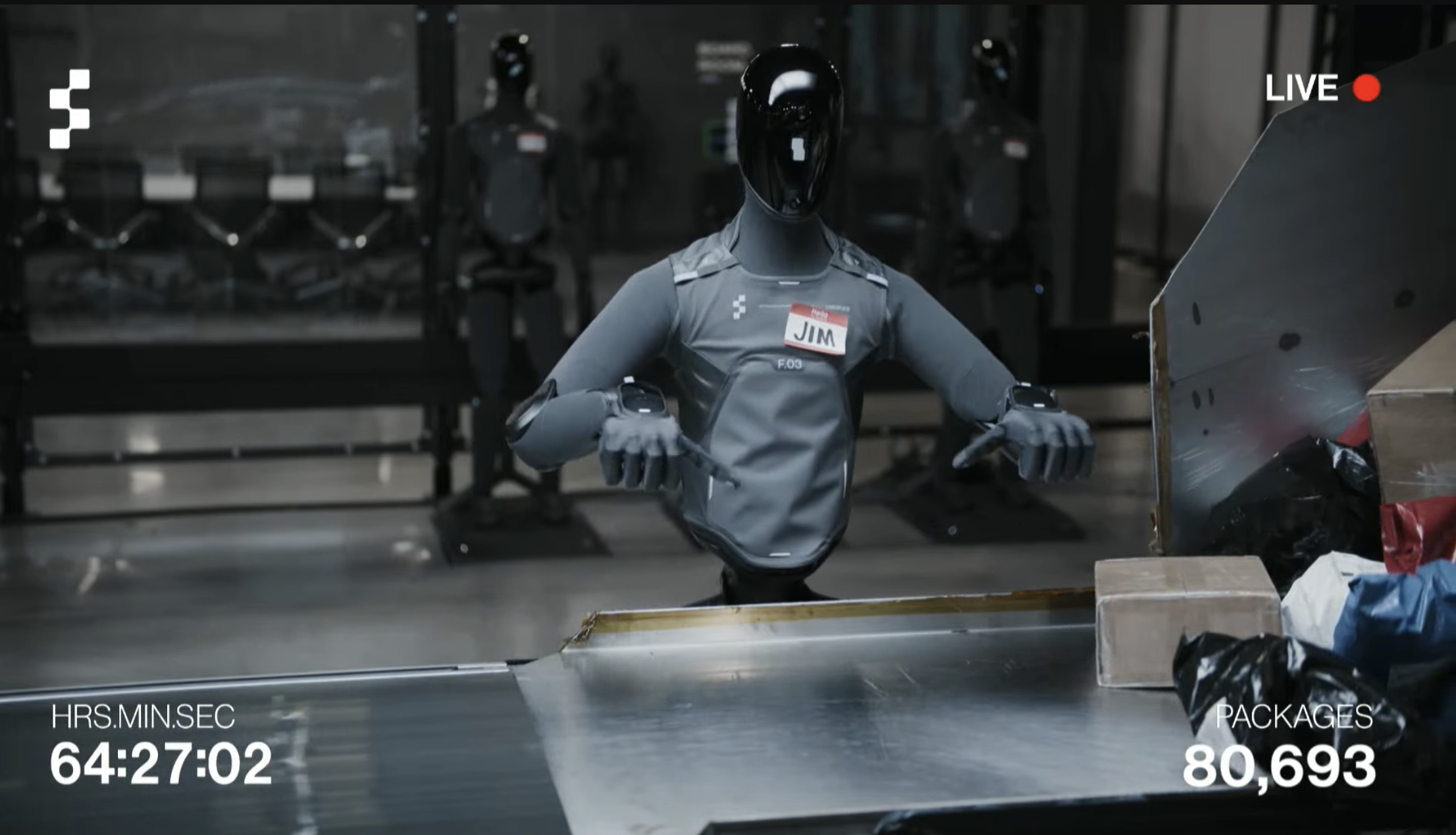
This is a screenshot of Figure AI’s YouTube livestream that started on May 13, 2026.
At its core, the project places a cadre of humanoid robots into a 24/7 conveyor sorting test, where they pick up small parcels and place them on a belt with their barcodes facing downward: a task designed to mimic a mundane but ubiquitous part of warehouse logistics.
Brett Adcock, Figure AI’s founder and chief executive officer, had explained this demonstration in a post he made on X on May 14, 2026. The post notes that the company’s plan was to demonstrate an eight-hour autonomous shift using Helix-02 (its ‘in-house neural network’) on F.03—but the run was extended after early success and now continues beyond the original target.
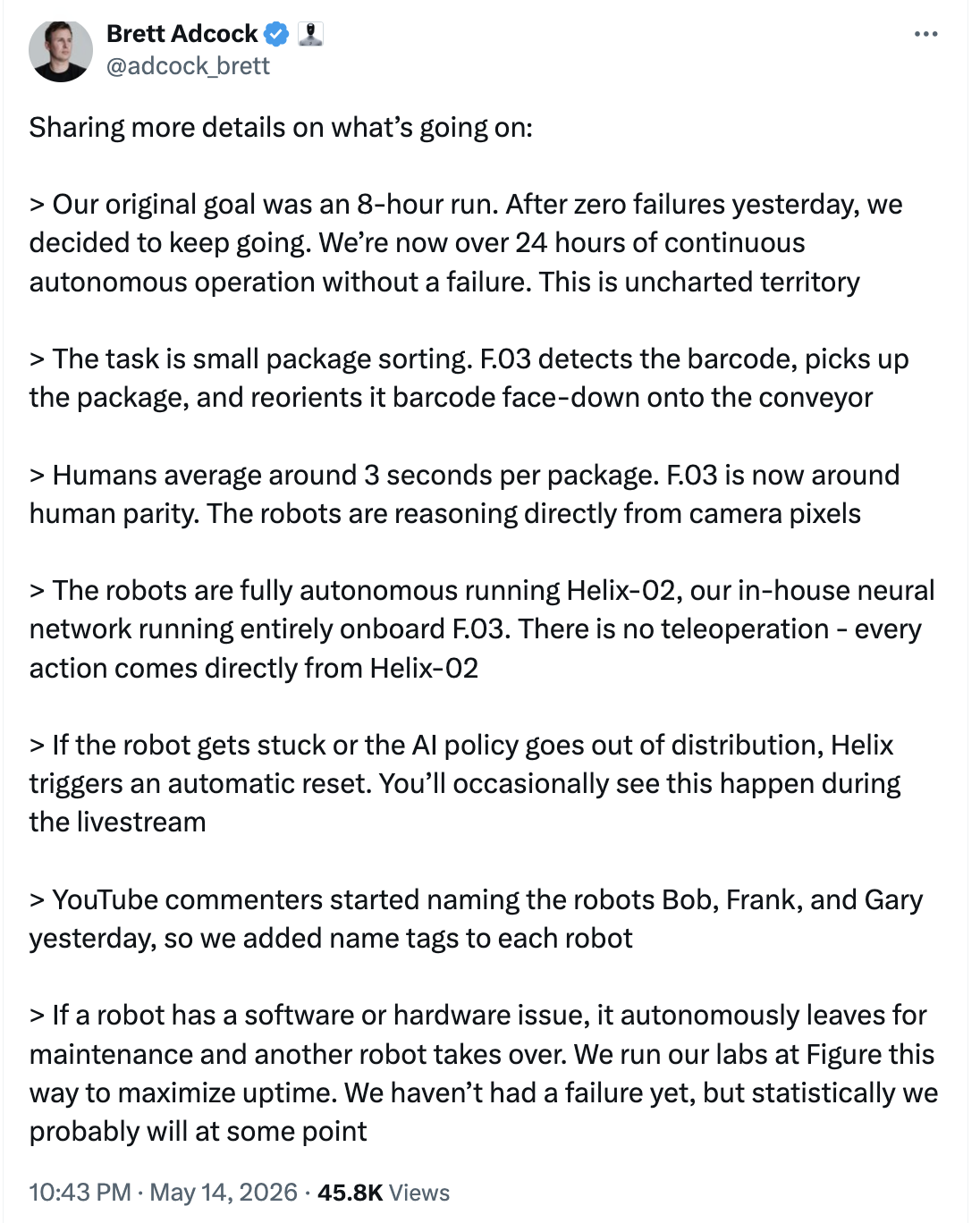
This is a clickable screenshot of Brett Adcock’s post on X made on May 14, 2026.
An American AI and robotics company headquartered in Sunnyvale/San Jose, California, Figure AI was established in 2022; it aims to mass-manufacture general-purpose autonomous humanoid robots that can function in complex environments such as warehouses, factories, and homes. With a multibillion-dollar valuation, the company develops multiple robot generations (e.g., Figure 01, 02, 03) and its own AI system called Helix to enable perception and action.
Helix-02, just to be clear, is the company’s Artificial Intelligence (or AI) software that is being used in this ongoing demonstration on its F.03 hardware (officially called the Figure 03), which is the physical humanoid robot that executes the movements.
Adcock’s May 14 post mentions that Figure 03—the robot model on display in the ongoing livestream—is now performing very close to the human average on the package-sorting task being captured in the demonstration. Noting that the robot was not being tele-operated but is ‘reasoning directly from camera pixels’, he also claims that its Helix-02 software resets itself in case of a malfunction; moreover, a Figure 03 ‘autonomously leaves for maintenance and another robot takes over’ if there is any kind of glitch.
A curious fact mentioned in Adcock’s post is that these robots were not initially assigned any names, but specific name tags were attached to each by the company after YouTube commentators started referring to them by different names!
Viewers are plentiful—but they include sceptics
While Adcock has been posting details on X, the company has provided very few details on its YouTube livestream itself. There, as at the time this report is being written, the company legend just says this: ‘Watch a team of humanoid robots running a full 8-hr shift at human performance levels. This is fully autonomous running Helix-02’.
This skimpy description has left many viewers—many of whom don’t even read what is written below a given video—quite confused or sceptical. Many viewers suspect that the livestream itself is AI-generated and that no real robots are involved; others come and go claiming that the robots shown at work are simply being tele-operated rather than learning and operating on their own. Still others claim that one robot, say ‘Rob’, is more efficient or better than another, say, ‘Gary’, and so on.
Viewers overall, however, seem to have been drawn to the hypnotic rhythm and novelty of humanoids performing repetitive motion without obvious breaks: part spectacle, part social experiment. The stream started on March 13, 2026 (UTC−7) and typically has fewer than 200,000 viewers at any given time.
Whether this livestream is viewed as proof of concept, robotic endurance test, or elaborate demonstration theatre, it appears to be evolving into a focal point for wider debate about what humanoid labour might mean—both technically and socially—well before such machines become routine on actual warehouse floors. For his part, Adcock posted an update on this matter earlier today, May 16, 2026, claiming that the livestream will continue until a robot fails!

This is a clickable screenshot of Brett Adcock’s post on X made on May 16, 2026.
Crucially absent from the demonstration so far is a live record of energy consumption per second — and a comparative benchmark against ordinary human labour in a similar factory setting.
The livestream itself can be found here: https://www.youtube.com/watch?v=luU57hMhkak.
Piyush Mathur, Ph.D., is the author of the book Technological Forms and Ecological Communication: A Theoretical Heuristic (Lexington/Bloomsbury, 2017). If you have any comment to make on this report, please use the box below; if you wish to contact the author or Thoughtfox, send us a message via Contact link.