
An Indian schoolteacher’s video of massaging a young pupil’s shaven head draws polarised social-media reactions
by Piyush Mathur
A video of an Indian schoolteacher ‘mock-massaging’ the shaven head of an elementary-school boy—presumably in mourning following a death in his family—began circulating on social media earlier this month, eliciting sharply polarised reactions among Indian viewers. The division appears to reflect a gap between traditional and relatively modern (and emerging) frameworks of school education and adult-child relations in South Asia.
In most communities of India, the death of a close relative is signified by the tonsured heads of the surviving males. In the video, the teacher vigorously and laughingly massages the boy’s smooth head, apparently making light of the presumed family bereavement and deliberately evoking laughter from several other pupils sitting in the classroom.
This is no ordinary massage, either: The teacher is exaggeratedly acting out the role of a traditional South Asian barber crossed with that of a tabla player (and doing so quite expertly, one might grudgingly add). The boy, meanwhile, remains clasped between the teacher’s legs, which hold him steady.
While the teacher and the boy’s classmates seem thoroughly bemused by the massaging activity, the boy’s face remains hidden from the camera. One can clearly notice the ‘public performance’ dimension to the teacher’s act, which includes measures of insensitivity and callousness toward the boy—but also no dearth of a bond with the class generally.
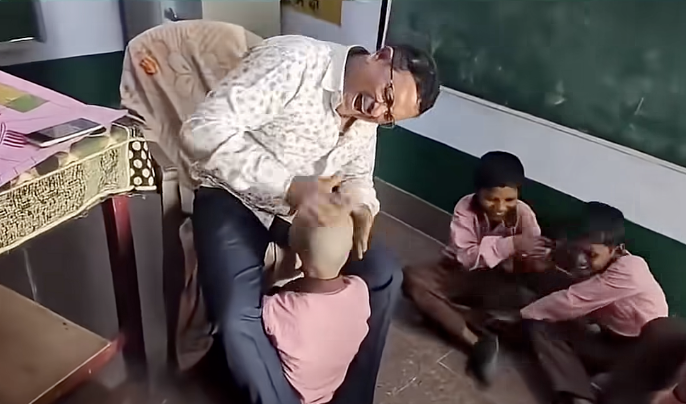
This is a screenshot of a video showing an Indian teacher giving a ‘mock’ head massage to a pupil in the classroom.
(Public domain)
That the teacher saw nothing wrong with massaging the tonsured pupil in the classroom is evident from the fact that he uploaded the video, complete with background sounds, to his own Facebook profile. The details related to this incident were reported by Jagaran, a major Hindi newspaper.
One might suggest that the teacher’s attitude throughout this episode reflects the hold of a traditional framework of school education and adult-child relations in South Asia. In this framework, which persists particularly in rural and quasi-rural areas, the teacher can act as a roguish—somewhat obnoxious—public parent, intrusively coercing a pupil into an uncomfortable situation, as if to prepare him for life’s usual challenges and draw him into a broader realm of sociability. Some might consider this traditional mode of classroom discipline to be akin to ‘tough love’, though inter-subjective emotions, strictly speaking, tend not to be part of the mix.
Sharply divided public opinions
Writing in Hindi, many Facebook commentators resonated with that older framework. One commentator wrote, ‘If positively interpreted, this [incident] may indicate that a crying child was made to laugh’ (except that the child, as noted previously, is neither crying nor laughing in the video). Another commentator wrote, ‘Perhaps it is not [an act of] mockery but [of] love’—a sentiment that many other commentators also shared. Using several ellipses, one person wrote:
No, this is not called mocking… This is love between the master and his pupil as well as the rest of the pupils… Any person above the age of 30…would have done something similar to his own child or a child of his family… Other than that, opinions will differ [on this incident].
However, many other commentators, located firmly within the newer framework of teacher-pupil/adult-child relations, sharply dissented from the teacher’s approach, which they deemed insensitive or fundamentally inexplicable. Without using a question mark, one person asked, ‘If a teacher does this, then what would the children do’. Another wrote, ‘Give the same respect to others that you want for yourself,’ implying that the teacher was disrespectful toward the pupil.
Some commentators highlighted the psychological damage that the teacher’s behaviour may have brought upon the pupil in question; still others wondered about how it may have affected the boy’s classmates.
Using a variety of pointed idioms, many other commentators sarcastically predicted that, with the video having come to the attention of the media and the authorities, the teacher would now be taken to task by the administration. Several commentators used the words ‘massage’ and ‘tabla’ to characterise the teacher’s upcoming administrative ordeal, whose prospects seemed to amuse them no end.
Apparently alert to the rise of a new approach to teacher-pupil/adult-child relations at the expense of the one briefly exhibited in the video, at least one Facebook commentator remained apprehensive of the new paradigm. Skipping punctuation in his statement, he rued how times have changed during his own lifetime: ‘Our heads were tapped like this a few times too many by our master ji but in this modern era people have become too clever by half and over smart’.
Writing in English, an Instagram commentator had similar thoughts. He noted that pupils in his time received far rougher treatments than what this teacher gave to the pupil in the video. ‘Hilarious! But this is nothing compared to my high school day's punishment’, he remarked, overlooking the fact that the pupil in the video is too young to be even a middle schooler.
Overall, Instagram comments, written predominantly in English, reflected the same type of divide regarding the video as their Facebook counterparts.
Concluding remarks
Jagaran reports that the incident occurred at Birauli Primary School in the Saifai Development Block, Etawah district, Uttar Pradesh. The teacher, Mr. Dinesh Kumar Mathur, was suspended immediately after the video came to the attention of the Basic Education Officer, Dr. Rajesh Kumar. No statements from the boy’s family have been reported yet.
Some social-media links to the video, of varying lengths, are as follows:
https://www.instagram.com/reels/DeUbzQxv15i/