
Ebonyi State Facebook reel prompts action from Nigeria’s Advocacy for Alleged Witches (AfAW)
by Thoughtfox staff
A Facebook reel posted by the account ‘Kokobronx’ has prompted the human rights organisation Advocacy for Alleged Witches (AfAW) to dispatch an investigator to Amasiri, a five-village town in Afikpo North Local Government Area of Nigeria’s Ebonyi State.
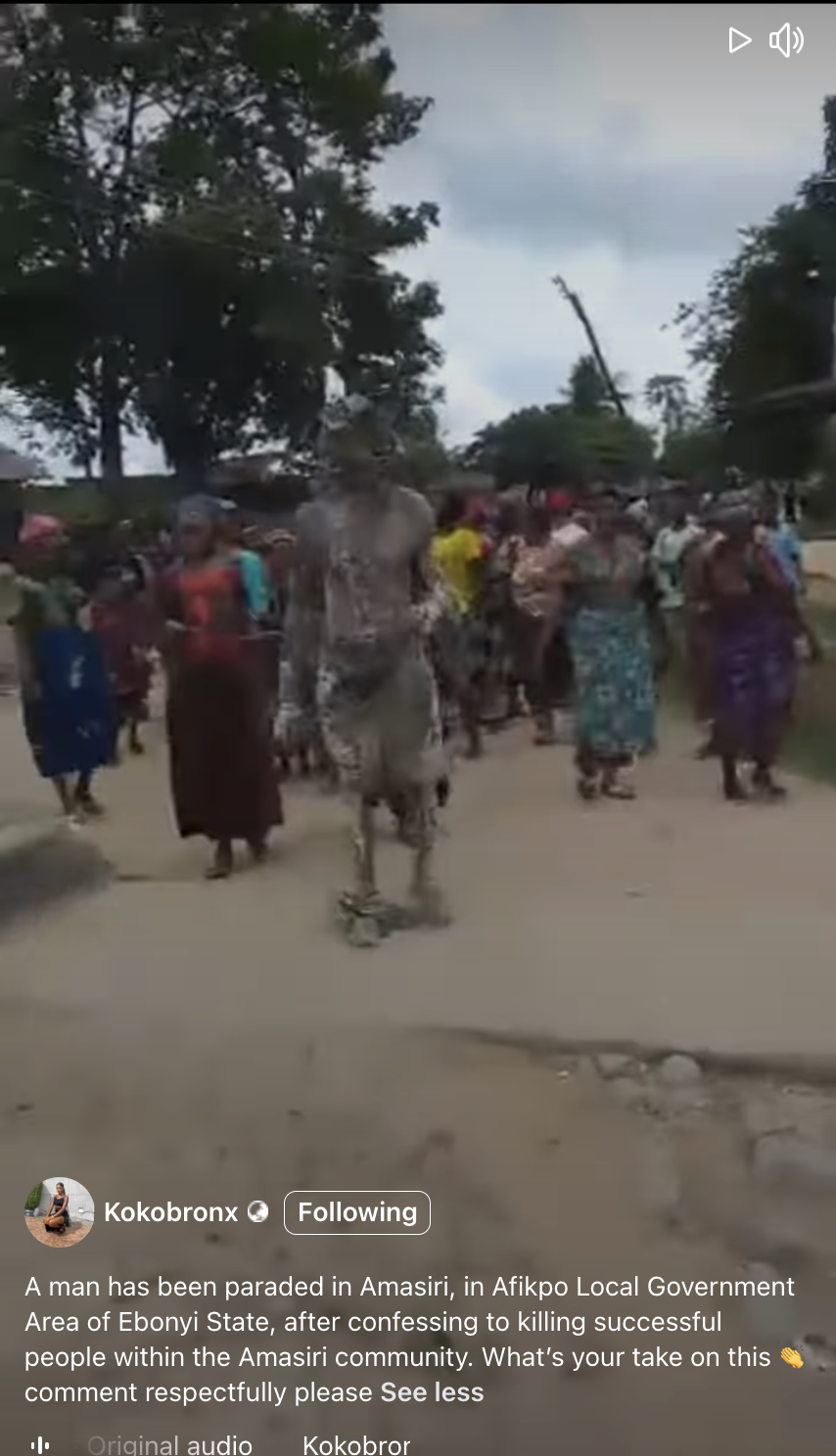
This is a screenshot of the Facebook reel posted by Kokobronx on May 15, 2025.
Timestamped May 15, 2025, this less-than-a-minute-long video shows a shirtless man, his body streaked with white paint and/or ash, being led forward by a large group of singing women, some of whom ease into dancing sometimes.
A couple of chains—and possibly a rope—are tied around the man’s waist, extending toward his arms and down along his legs. One of his feet appears to be bound with a clump of chain as well.
The video is a bit blurry, but the man’s head and face are also covered in the same white paint and/or ash—along with what appears to be other unidentified materials. He walks slowly and without resistance, his gaze drifting vacantly in different directions.
The reel’s caption points out that he has been ‘paraded…after confessing to killing successful people within the Amasiri community.’
Dr. Leo Igwe, the founder and chief executive officer of AfAW, reposted the reel on his Facebook profile on May 17, 2025, claiming that the video has been confirmed to be genuine—and the incident did take place. Igwe’s post adds that AfAW has sent an organisational ‘advocate’ belonging to that area to the spot where this incident allegedly took place.
In response to a question on his post, Igwe also clarified that the advocate told him ‘that being publicly paraded by women is a form of humiliation’ for a man in that community.
AfAW has initiated this investigation under the assumption, as Igew’s post suggests, that the video captures an instance of ritualistic abuse of a man fuelled by '“fetish” beliefs’.
These types of incidents happen intermittently across Nigeria (and many other parts of the world) where individuals, often already isolated or vulnerable due to factors like neurodiversity, are accused of crimes they did not commit. Many are then subjected to collective persecution, including ritualistic violence, torture, or even death, under the guise of metaphysical or spiritual justification.
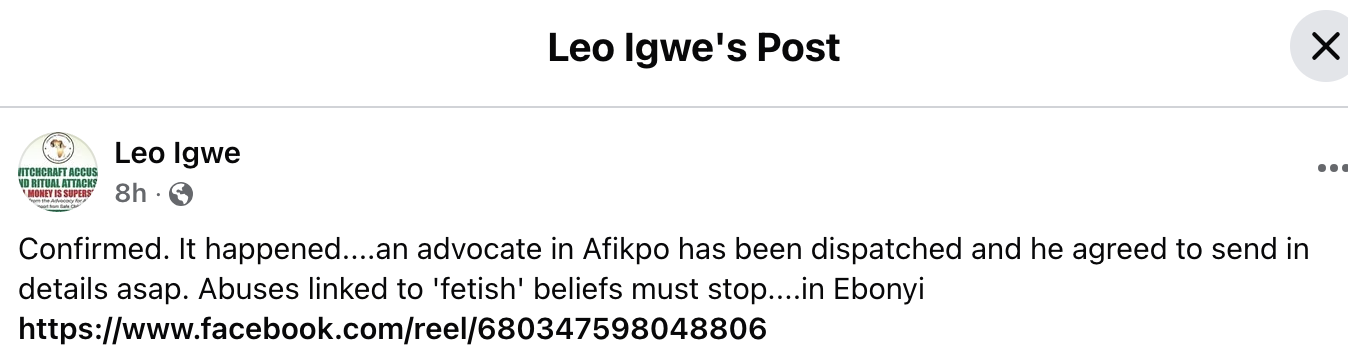
This is a screenshot of Dr. Leo Igwe’s post (dated May 17, 2025) regarding the Amasiri incident.
Despite the recurring nature of these so-called ‘witch hunts’, a strong, coordinated resistance against such practices has yet to take shape in Nigeria.
Igwe, for instance, was asked to pay a large sum of money late last month by the Abuja station of the African Independent Television (AIT) as a fee to appear on air and discuss ritual attacks like this alleged incident.
Kokobronx, the Facebook account that posted the reel capturing the Amasiri incident, has 129 K followers. Many comments on this reel go with the assumption, siding with the persecuting ritualists, that the man shown in the video did what he has been alleged to have confessed—and that he must be severely punished; there are many calls for his death in the comments. Some comments do raise objections to the whole spectacle, claiming that the man might be ‘mentally challenged’ and that superstitions are driving the people to parade him like this.