
Citing anti-Palestine bias, some authors withdraw from Emerald’s volume on decolonising management and organisation studies
by Dr. Piyush Mathur
A recently published peer-reviewed academic collection of articles on the theme of ‘decolonising’ management and organisation studies came under withering criticism on LinkedIn from some contributors claiming that it unfairly targeted Palestine-related references and discussion that were part of a submission.
Titled Decolonizing Management and Organization Studies: Why, How, and What, this open-access volume was published in August 2025 by the UK-based Emerald.
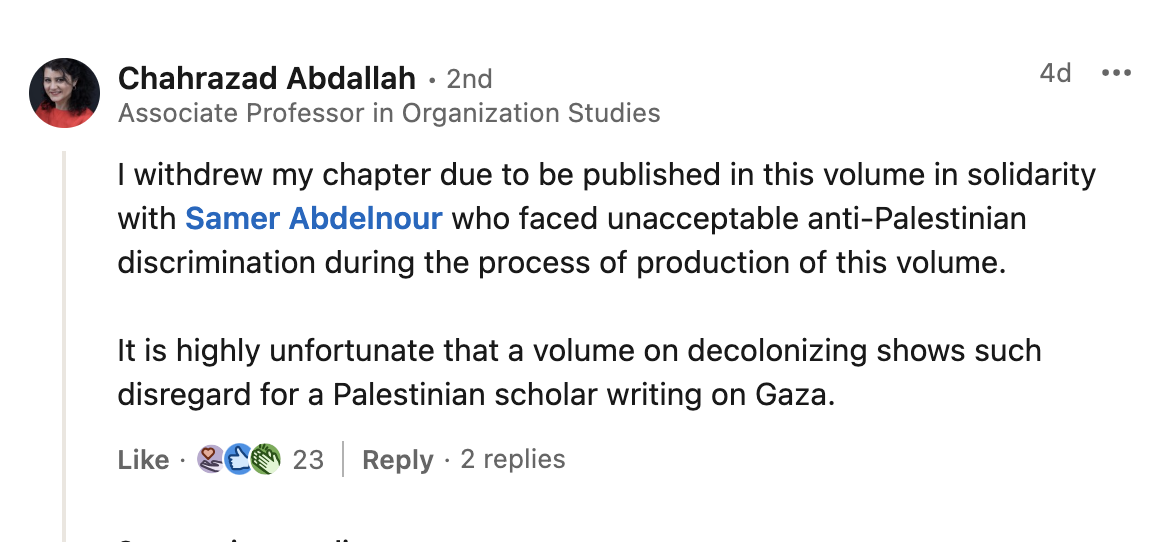
This is a screenshot of a LinkedIn post made by a contributor to the volume announcing her decision to withdraw her submission in solidarity with Abdelnour.
The allegedly victimised submission’s author, Dr. Samer Abedlnour—Senior Lecturer at the University of Edinburgh Business School—led the charge against the volume, claiming that he withdrew his submission owing to ‘months of targeted scrutiny including anti-Palestinian racism for writing about the genocide in Gaza.’ He also mentioned that two other contributors to the volume had followed his lead and withdrawn their own submissions.
One of those two contributors, Dr. Chahrazad Abdallah, an Associate Professor at Université du Québec à Montréal, acknowledged having withdrawn her accepted contribution in a follow-up comment; she noted that she had done so ‘in solidarity with Samer Abdelnour who faced unacceptable anti-Palestinian discrimination during the process of production of this volume.’
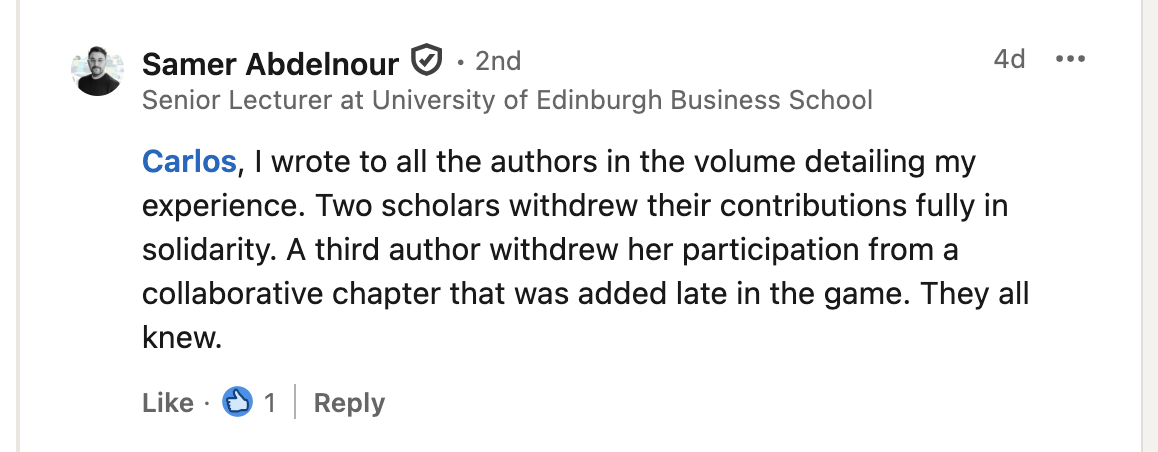
This is a screenshot of a LinkedIn comment made by Abdelnour regarding his experience with Emerald’s volume.
Subsequent comments by other researchers and observers—including those who had initially welcomed the post about the volume’s publication—generally supported Abdelnour’s line of action, expressing shock at the volume’s stance.
One commentator wrote, ‘I hope the authors who contributed to the volume were not aware of this. If they were, the lack of solidarity is shameful.’
To that comment, Abdelnour responded, ‘I wrote to all the authors in the volume detailing my experience. Two scholars withdrew their contributions fully in solidarity. A third author withdrew her participation from a collaborative chapter that was added late in the game. They all knew.’
Another commentator called for boycotting the book ‘if the reported discrimination had actually occurred.’
Even the academic who had made the original post welcoming the publication—albeit in the hackneyed hyperbole of LinkedIn—expressed his grief at the reported discrimination, clarifying that he ‘did not have any information about what happened in the backstage’ when he made his post.
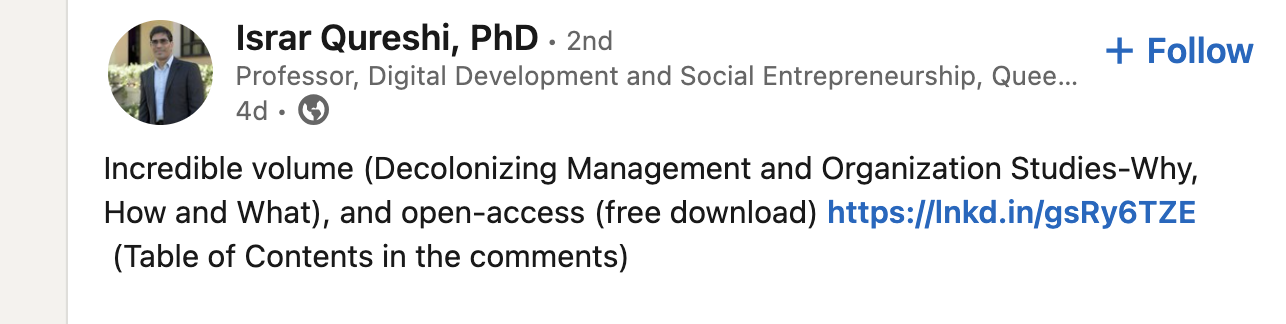
Dr. Israr Qureshi had hailed the volume in LinkedIn’s hackneyed hyperbole, but the volume attracted controversy quickly.
This is a partial screenshot of Qureshi’s post.
Abdelnour’s account of his aborted experience with the volume
Thoughtfox reached out to Abdelnour, who shared his entire experience in an almost 3-page writeup—and the details are nothing short of harrowing, pointing to unwarranted layers of audit that his submission was put through as well as an inconsistent, unreasonable and protracted process. All of that looks only the worse—much worse—when read in light of Abdelnour’s writeup’s opening words, which indicate that not only was his submission supposed to be the ‘Prologue’ to the volume in question, but also that he had been invited to write it. As for the rest of the details, the reader may go over Abdelnour’s writeup via its screenshots pasted further below—but its summary version deserves to be produced here.
The writeup points out that, early on, Abdelnour was forced to redraft his submitted 'Prologue’ into a ‘Chapter’ to be placed last in the volume, given that the Volume Editor (VE), a post-doctoral candidate, had altered the submission’s status, fearing that accusations of anti-Semitism may come his way and harm his own fledgling career—owing to the submission’s upfront discussion of the genocide in Palestine. However, the newly drafted chapter—though initially accepted by the VE—would end up attracting further objections, apparently from the Series Editor and other contributors to the volume, with the VE himself suggesting its lack of fit into the volume; at any rate, the VE would refer it to the Publisher’s legal vetting.
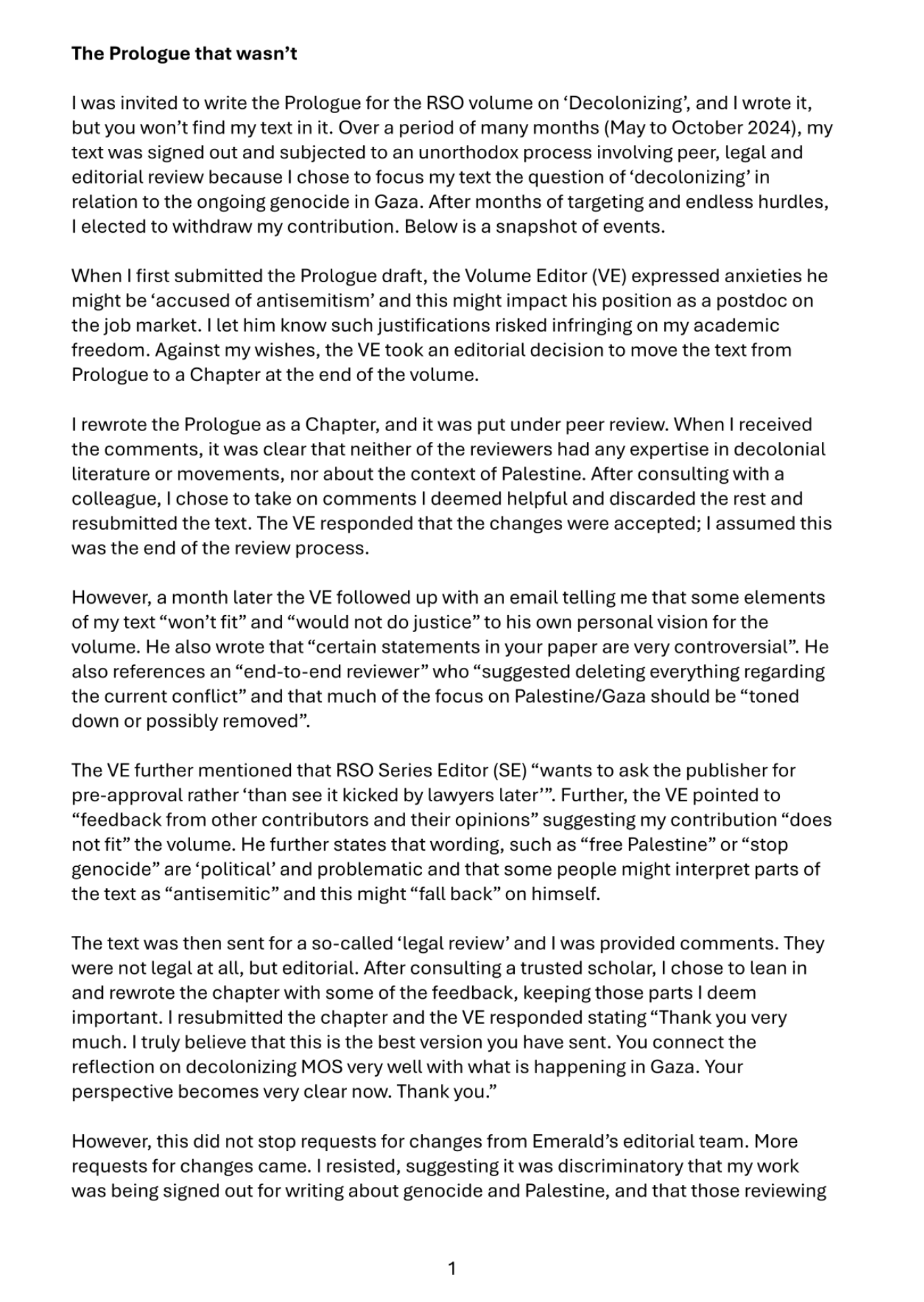
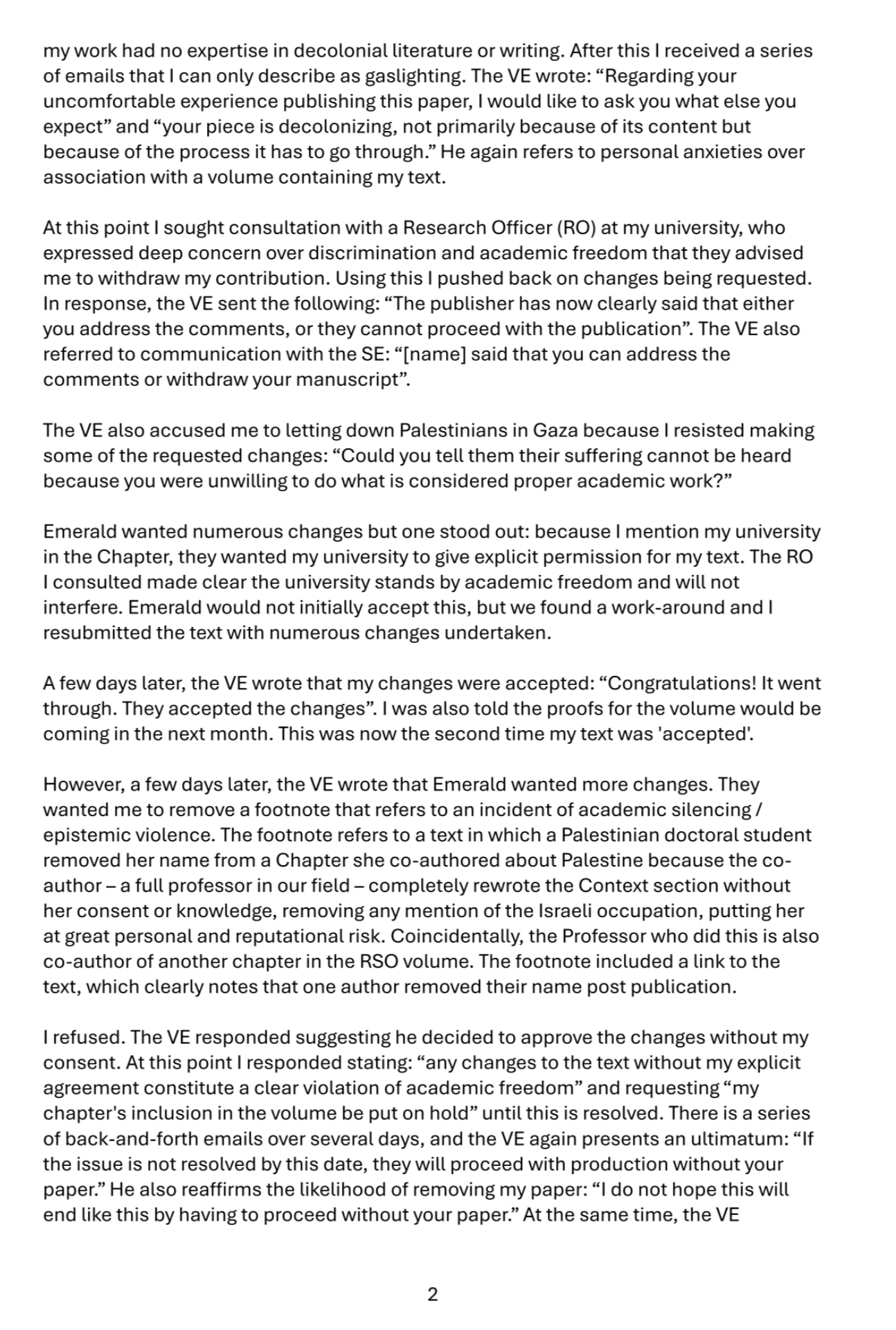
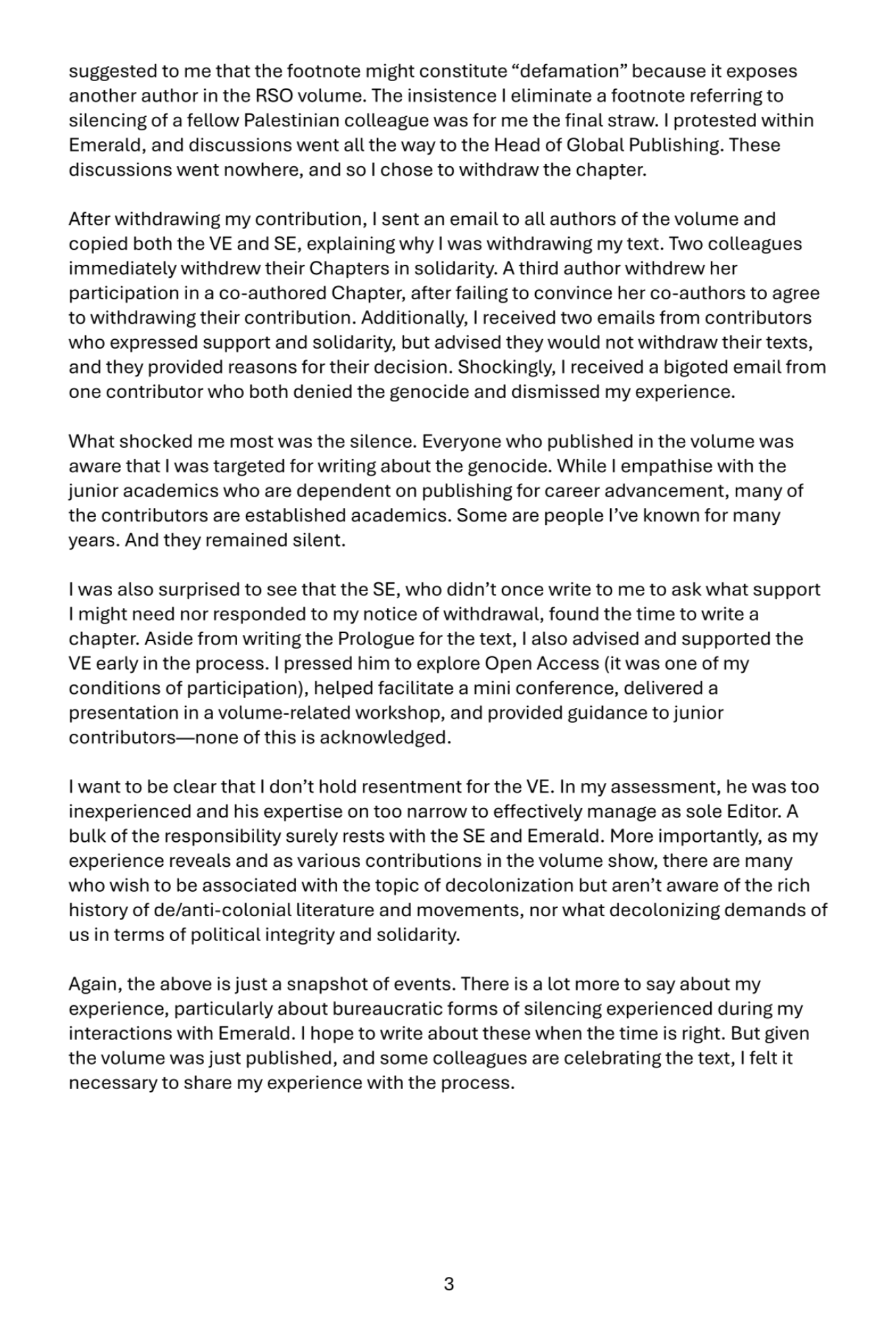
These are the screenshots of Abdelnour’s account of his experience trying to get his originally invitational piece into Emerald’s volume; Abdelnour shared this account with this writer and also posted it on his own LinkedIn wall subsequently.
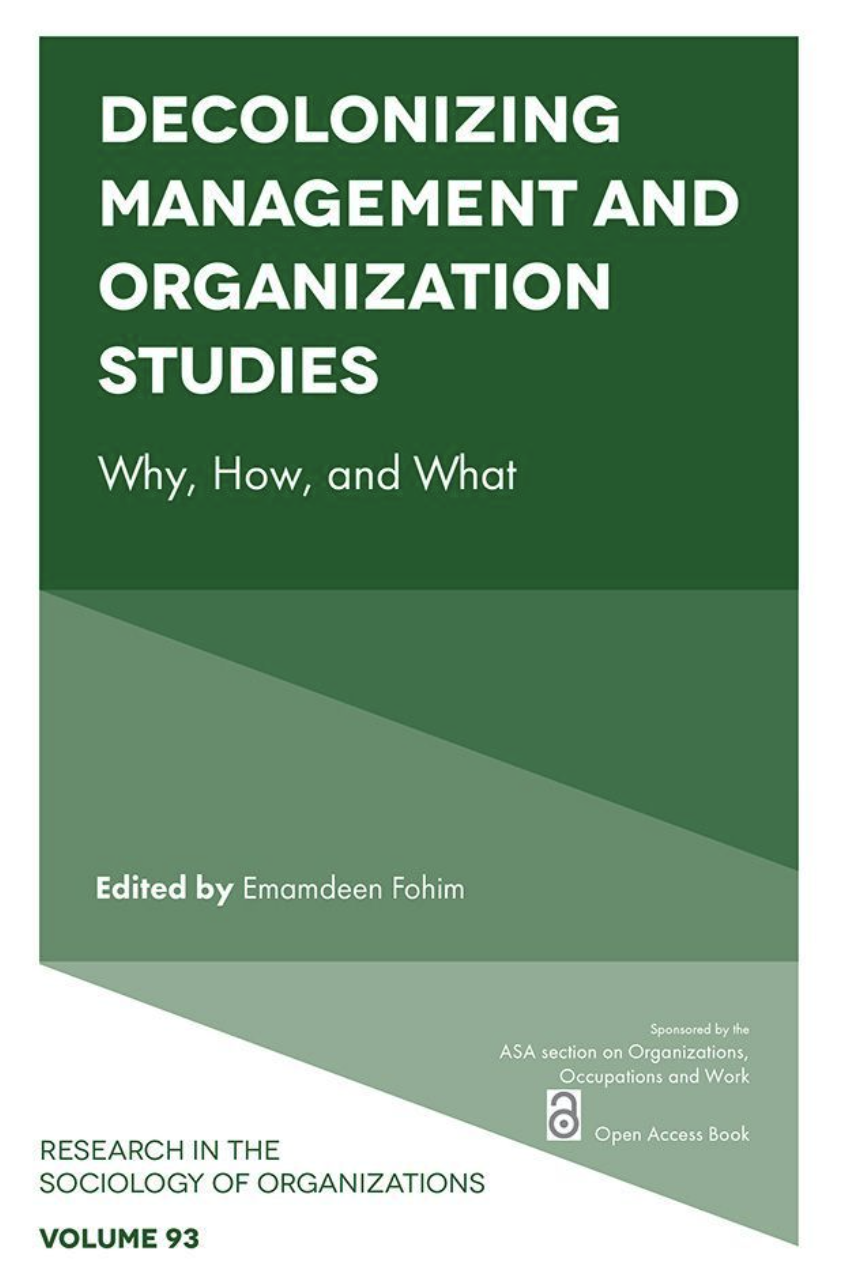
This is a screenshot of the cover image for Emerald’s volume, Decolonizing Management and Organization Studies: Why, How, and What (2025)
Abdelnour went along with the editorial inputs received following that ostensible legal vetting—he does not seem convinced that the process or its inputs were truly legalistic—and redrafted the submission a second time. His effort and its outcome were also deeply appreciated by the VE. Nevertheless, Emerald’s editorial team kept asking for further changes—apparently without the VE’s wholehearted consent; but when he resisted these new advised changes, his interaction with the VE briefly worsened. The VE wrote to him that the publisher required Abdelnour to implement the advised changes—including one that required the University of Edinburgh ‘to give explicit permission’ for his submission’s publication, given that it had mentioned that university in the article’s text.
Abdelnour succumbed even to these late-stage demands on the part of Emerald, and even received a congratulatory message of acceptance from the VE on his latest version. But ‘a few days later’, yet another change was asked of him by the publisher, the VE conveyed to him. Now he was asked to delete a footnote referring to an incident in which a Palestinian doctoral student had removed herself from the co-authorship of a Chapter in a book because her co-author, 'a full professor’, had deleted references to the Israeli occupation from it and rewritten ‘the Context section without her consent or knowledge’. Worse, Abdelnour points out, this full professor also happened to be a contributor to the Emerald volume to which his own submission had been made and was being unfairly scrutinised!
Abdelnour, however, refused to remove the footnote, even as the VE had apparently already approved its removal to the publisher without waiting for Abdelnour’s consent. Abdelnour then protested ‘all the way to the Head of Global Publishing’ of Emerald, and ultimately ‘chose to withdraw the chapter.’ He also conveyed his decision and the reasons behind it to all the other contributor—leading to withdrawals by two other solo contributors, and a co-author withdrawal from a third contribution; two additional contributors expressed their solidarity with him privately but refused to withdraw their own entries for their own reasons. He claims also to have ‘received a bigoted email from one contributor’ denying the genocide in Palestine.
Abedelnour concludes his writeup by largely blaming the Series Editor and the publisher rather than the VE, whom he considers ‘too inexperienced’ to have properly discharged his duties ‘as sole Editor.’ He also criticises a lack of awareness among fellow academics from management-cum-organisation studies of what decolonization entails and its research history—and takes to task the ‘bureaucratic forms of silencing’ that he had been subjected to by Emerald.
VE’s response to Thoughtfox on this incident
Thoughtfox reached out to Dr. Emamdeen Fohim for a response to Abdelnour’s allegations against the volume and Emerald.
Fohim responded via an email message received on August 21, 2025 by thanking Thoughtfox for seeking a response, but noted that he was ‘not planning on making any statement right now.’
Concluding remarks
The LinkedIn chain of post-cum-comments, which started around mid-August 2025 and is reported in this article, can be accessed via this link: https://www.linkedin.com/feed/update/urn:li:activity:7361342984468025345
That chain would indicate that several researchers are happy that this volume has come out.
The Emerald controversy, however, has to be placed within the context of the general political and legal pressure against pro-Palestine expression in the UK—whose recent instances include the arrests of over 400 protesters in London, the abuse of the Public Order Act 2023, and multiple reports of the suppression of pro-Palestine campus protests and academic suppression. The internalised fear of censor, legal action against Emerald cannot be underestimated. Broadly, the UK, of course, is foundational to the coercive establishment of Israel inside the imperial British Mandate of Palestine.
While Abdelnour’s self-reported experience with this volume is painful and regrettable (if not outright shameful—for the specific insinuation of ethno-historical discrimination that he has had to face), readers of Thoughtfox should not be shocked to learn that intractably unreasonable demands for modifications in academic submissions have been routine for at least two decades.
This writer is intimately aware, for example, of a Mediterranean postdoctoral researcher’s relatively recent experience with a flagship journal focussing on Central Asian themes. That researcher’s submission was put through a review process that went back-and-forth for 2.5 years because three separate sets of reviewers would not come to an agreement about its quality and/or style; ultimately, the journal’s editor had to intervene and publish a version that was a far cry from the original submission! All of that was done with the author’s ‘consent’, of course.

Dr. Piyush Mathur is the author of the book Technological Forms and Ecological Communication: A Theoretical Heuristic (Lexington Books, 2017).
Readers may post any comments into the box below; if they wish to contact Thoughtfox, they may use this form to send their messages: Thoughtfox.xyz/contact