
EU parliamentarian Dr. Salla rallies against the Danish version of the ‘Chat Control’ proposal
by Piyush Mathur
(This report was updated on September 01, 2025.)
Via a LinkedIn post, Dr. Aura Salla, a Member of the European Parliament (MEP), has declared that she will oppose the Danish EU Presidency’s rendition of the EU’s so-called ‘Chat Control’ proposal. Calling it ‘an even more radical, and unbelievable version’ of the EU’s prior proposals, Salla appears both shocked and frustrated by the Danish take on this evolving matter.

This is a screenshot of Dr. Aura Salla's photograph she shared on LinkedIn on August 11, 2025 along with her post discussed in this report.
Dated August 11, 2025, Salla’s post also urges EU citizens and institutions to oppose the Danish proposal, warning them that it entails mandatory mass scanning of private communications, client-side surveillance, and the breakup of end-to-end encryption. Highlighting the fact that the proposal exempts government and military accounts from the scanning, she calls it ‘an authoritarian leader’s dream.’
Salla has highlighted two key dates in her post: September 12, when the EU member states are expected to meet and finalise their positions on the Danish proposal; and October 14, when a vote on the proposal is expected to take place. Several media outlets have also mentioned these dates, noting October 14 to be the date for a European Council vote on the measure.
Neither of these dates, however, is marked out in the EU Legislative Train Schedule, which stops on April 29, 2024—despite having been last updated on June 20, 2025; this could suggest that both the meeting and the vote are tentatively scheduled as of now. (Thoughtfox has sent a query to the EU Members' Research Service in this regard.)
What is the ‘Chat Control’ or CSAM proposal?
The so-called CSAM (Child Sexual Abuse Material) detection proposal is formally titled the ‘Proposal for a REGULATION OF THE EUROPEAN PARLIAMENT AND OF THE COUNCIL laying down rules to prevent and combat child sexual abuse’. The proposal would require messaging platforms—including end-to-end encrypted services like WhatsApp, Signal, and Telegram—to scan private communications for CSAM ahead of their encryption and relay.
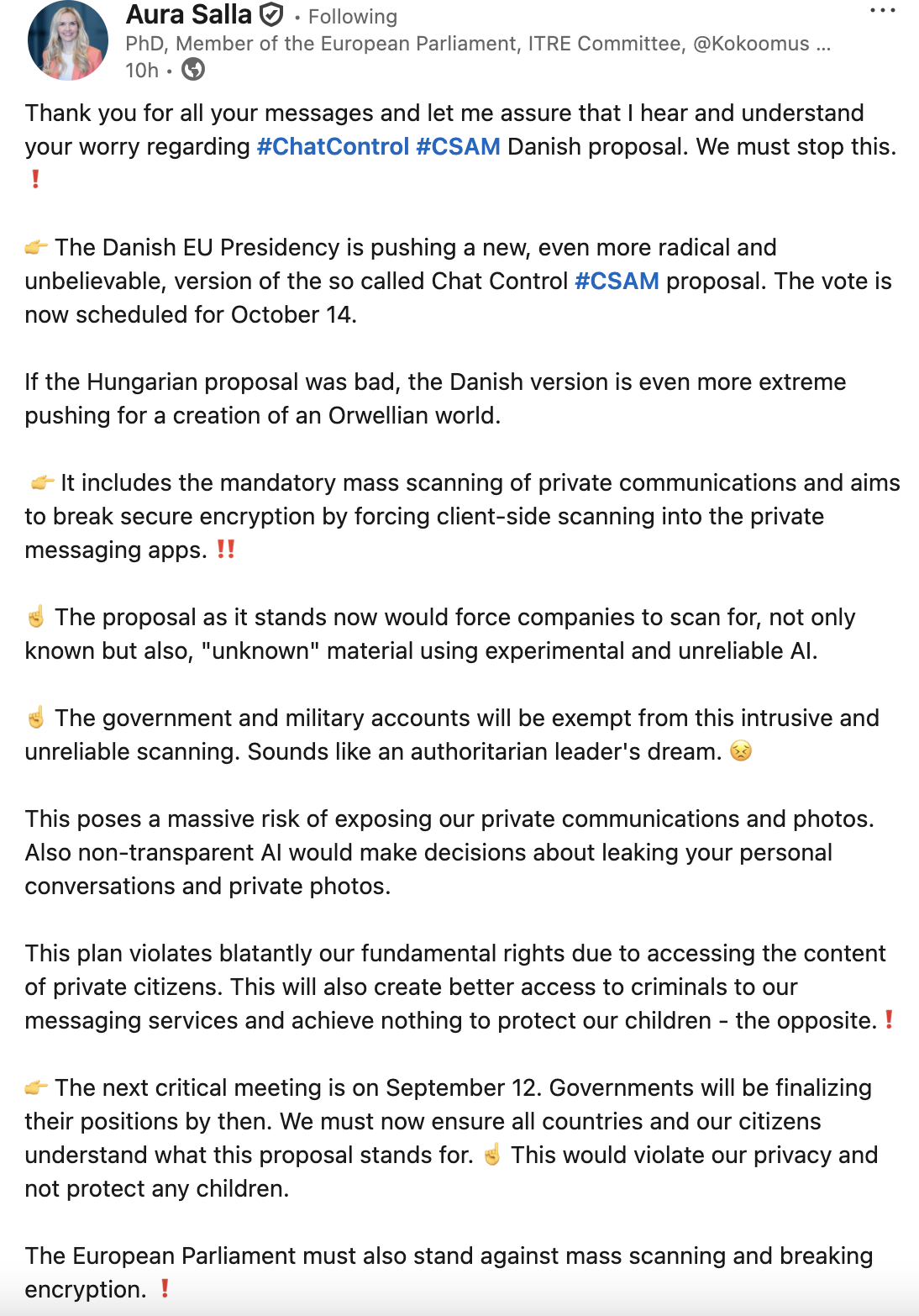
This is a partial screenshot of Dr. Aura Salla’s LinkedIn post dated August 11, 2025. (Screenshot credit: Thoughtfox)
Initially tabled in May 2022, the measure has already toyed with alternatives like ‘consent-based’ and ‘voluntary scanning’ frameworks—but rejected them out of privacy and implementational concerns. Factors related to the growth of Artificial Intelligence (AI) tools, an expanded global room for political authoritarianism, and a fear of technological feudalism may have prompted some of the EU member states to continue to consider introducing mandatory scanning, network blocking, age verification, and other restrictions.
Proponents argue that these checks are necessary to combat child abuse material effectively; critics warn that they are tantamount to mass surveillance and fundamentally weakens encryption and privacy. Despite repeated resistance—most notably from Germany, Belgium, the Netherlands, and others—a renewed push by Denmark (reportedly backed by France, Belgium, Hungary, Sweden, Italy, and Spain) has brought the measure back to the table.
A qualified majority in Council— comprising ‘at least 15 countries with 65% of the EU population’—could see the measure passed in October with German support. Quoting outside analysts and political observers, TechStory, AInvest, and EU Today have all stressed the significance of Germany’s stance to the future of this measure.
In her post, Salla—who represents Finland in the European Parliament—has framed the policy as invasive, technically unreliable, and ultimately a threat to privacy with little child-protection benefit. Her rallying cry against the measure may be easier to appreciate if it is kept in mind that AI-enabled automated scanning can yield high error rates. (It should also be noted here that Salla was Meta Platform’s Public Policy Director and Head of EU Affairs through 2020-2023.)
As of August 21, 2025, Salla’s LinkedIn post—whose screenshot is included in this report—has received 2817 reactions and shared 309 times within the network; it can be accessed via this link: www.linkedin.com/posts/aurasalla_chatcontrol-csam-csam-activity-7360575751525494784-CjzR
Update (September 1, 2025): Thoughtfox received a reply to its query from the EU Members' Research Service’s Mar Negreiro. She noted in her message that the Legislative Train Schedule is updated ‘every month’—and that its text would be updated again once the Council reaches a ‘common position’ on the CSAM proposal and when there is a ‘legislative briefing’ about it. Negreiro also highlighted in her message an updated segment in the Legislative Train Schedule link cited in the Thoughtfox report; the segment has the following statement:
At the Council, work is ongoing but no common position was reached in 2024. Neither the Belgian nor the Hungarian presidencies of the Council of the EU managed to reach an agreement by the end of their mandates.
The Polish Presidency of the Council did not reach a Council position. The Danish Presidency of the Council presented its position on 11 July 2025.The next Council debate and vote will reportedly take place on 14 October 2025.