
French lawyer’s AI tool aims to simplify International Criminal Court case research
by Piyush Mathur
French international criminal lawyer and researcher Jeanne Sulzer has unveiled a new AI-powered research tool—a virtual platform—designed to make exploring International Criminal Court (ICC) case law faster and more accessible than previously.

Jeanne Sulzer,
founder of Impact Litigation
(Image credit: Public Domain)
Sulzer’s LinkedIn announcement of 6 July, 2026, positions the tool—prosaically titled ‘Research Guides for International Criminal Justice’—as a free practical aid for navigating the ICC's extensive body of jurisprudence. The tool—which we can refer to via its partial initialism RG-ICJ—seeks to reinforce fact and rigour in legal research amid rising fears related to AI hallucinations in documentation and correlated errors in argument and judgment.
According to Sulzer, RG-ICJ enables users to explore ICC cases more dependably by helping them locate relevant decisions and legal material with greater efficiency and accuracy. Most crucially, the platform, covering 16 jurisdictions, is programmed to ‘locate the official document in the tribunal's public archives’ before citing it as a judgment—and to admit its failure to find it if the document is not in the archives (instead of fabricating a false reference).
This self-limiting dimension of the assistant should comprise at least one important way out of the growing problem of AI-fabricated false references in legal filings. But an added aspect of convenience stressed in Sulzer’s post is that ‘the whole suite is also available as an MCP server — a ready-made connector that plugs the 13 guides, the citation-verification workflow and the case-law search directly into AI assistants like Claude’.
What Sulzer means to refer to there is Anthropic’s Model Context Protocol (MCP)—which her platform has relied upon via GitHub’s MCP server to make itself widely utilizable across a widening spectrum of AI agents. But the platform is also already integrated into the system of Anthropic’s collaborator Lawve AI—a leading Claude-based ‘AI agent skills hub for law’, to use some words from its self-description. (Just for reference, one might suggest that the Harvard Law Skills Hub is a structural and technical parallel to Lawve AI, though the former is geared toward legal education rather than litigation itself.)
Explaining how to install the tool in Claude, Sulzer notes (in a follow-up comment to her own post) that users must first create a project on Claude (and give it a name, say, ‘ICC research’). They must then open the GitHub repository and download a tribunal folder's SKILL.md file and the files in its references subfolder (for example, from the icc/ folder). The user must then upload those files as the project's ‘knowledge’, and ask questions within that project, where the tool checks every citation against official archives and states when it cannot find a source.
Sulzer adds that ‘pro subscribers’ can instead enable the tool in every chat by zipping an entire tribunal folder (rather than the files inside it) and uploading the zip file through the following pathway: Settings → Customize → Skills → Create skill.
Background
The launch of RG-ICJ has emerged from Sulzer’s broader Impact Litigation Lab (ILL) initiative, which develops digital resources for international criminal justice, victims' rights, and strategic litigation. Itself founded only three months ago, the ILL—which has collaborated with Sciences Po Paris, Amnesty International France, and the American University of Paris Justice Lab, among other organisations—already offers searchable resources covering international tribunals, reparations mechanisms and victims' rights before the ICC in English, French and Arabic.
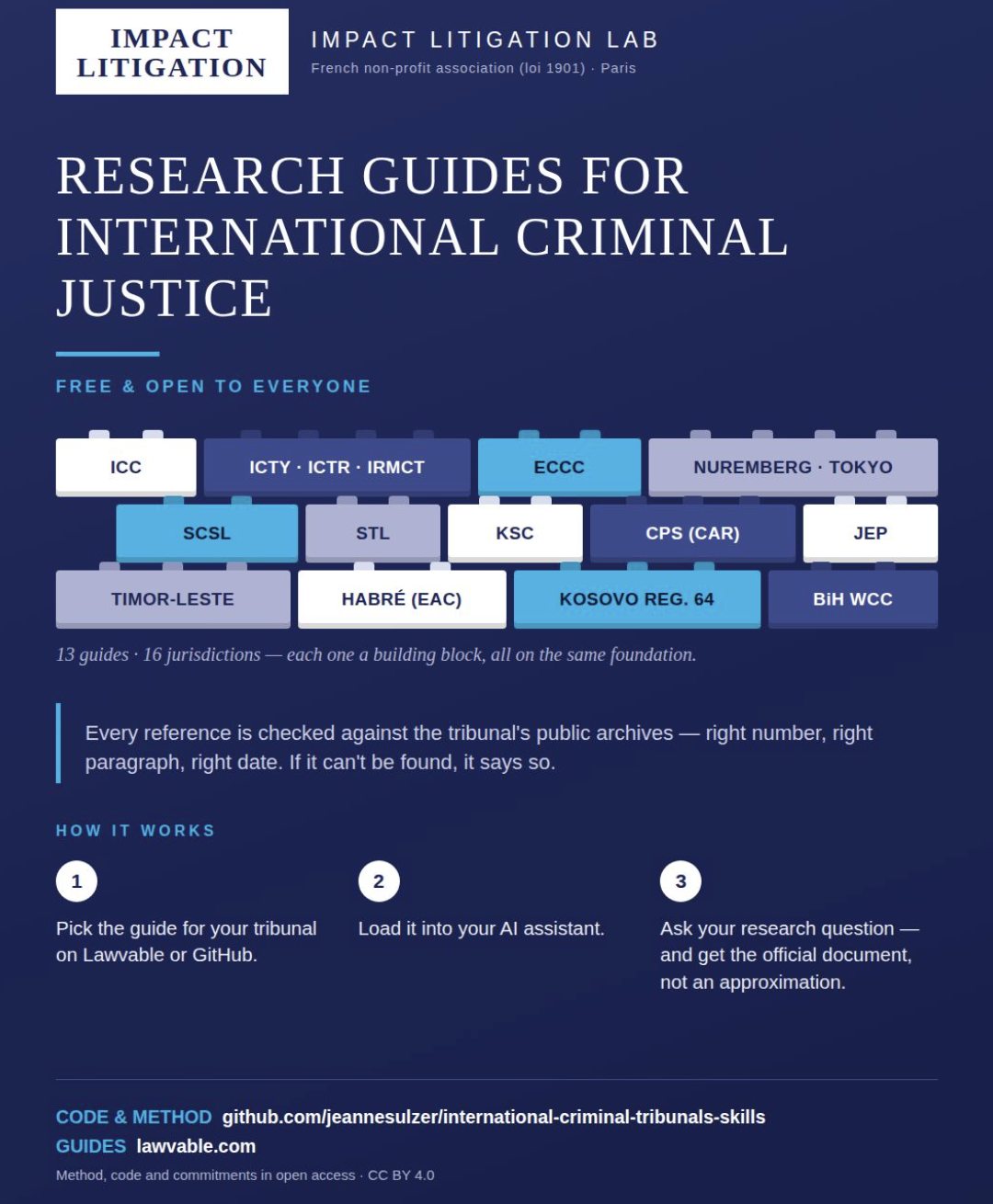
This image, circulated by Jeanne Sulzer, the founder of Impact Litigation, provides a panoramic view of her AI-powered research tool.
(Credit: Jeanne Sulzer)
Both RG-ICJ and ILL are non-profit, research-oriented components of Sulzer’s Paris-based law firm, Impact Litigation (IL), which focusses on ‘representing victims of international crimes and terrorism’, per its website. Given its hyperspecialisation, IL can be considered a ‘boutique’ firm—in the parlance of tlaw industry.
The response to Sulzer’s announcement on LinkedIn has been entirely positive so far. Viewers’ comments on her LinkedIn post described the new tool as a valuable resource for practitioners and researchers, congratulating Sulzer on expanding access to specialised legal knowledge. Several noted that AI has significant potential to reduce the time spent searching complex legal materials, while emphasising the importance of expert oversight when using such technology in legal research.
The launch reflects a growing trend towards applying generative AI to highly specialised legal domains. Rather than offering general-purpose legal assistance, Sulzer's tool focusses on a single jurisdiction, aiming to provide more reliable and targeted support for those working with ICC jurisprudence and international criminal law.
Thoughtfox readers may recall one of the earliest high-profile cases involving AI-generated fake citations. In late December 2023, news reports revealed that Michael Cohen, himself a lawyer, had unknowingly given his attorney, E. Danya Perry, three fabricated legal citations after relying on information generated by Google Bard.
Sulzer’s LinkedIn post is available on the following Unique Resource Locator (URL): https://www.linkedin.com/feed/update/urn:li:activity:7479787510919933952

Piyush Mathur is a member of the Coalition for Independent Technology Research (CITR).