
OSINT researchers contradict Indian government's claim on PAFF’s ties
by Piyush Mathur
In a LinkedIn post made on June 6, an Indian researcher—Mohit Vashisth—claims that the People's Anti-Fascist Front (PAFF) is not a proxy of Jaish-e-Mohammad (JeM), as often asserted by India’s Ministry of Home Affairs, but instead operates under the influence of Lashkar-e-Taiba (LeT). (Both JeM and LeT are Pakistan-based terrorist organisations.)
A doctoral candidate and Head of the Pakistan Project at the Centre for Security and Strategy Studies at the Jindal School of International Affairs (JSIA), Vashisth credits Nikita Vats (a Doctoral Research Fellow at the same institution) as the study’s co-researcher. Vats shared his post on her own profile.
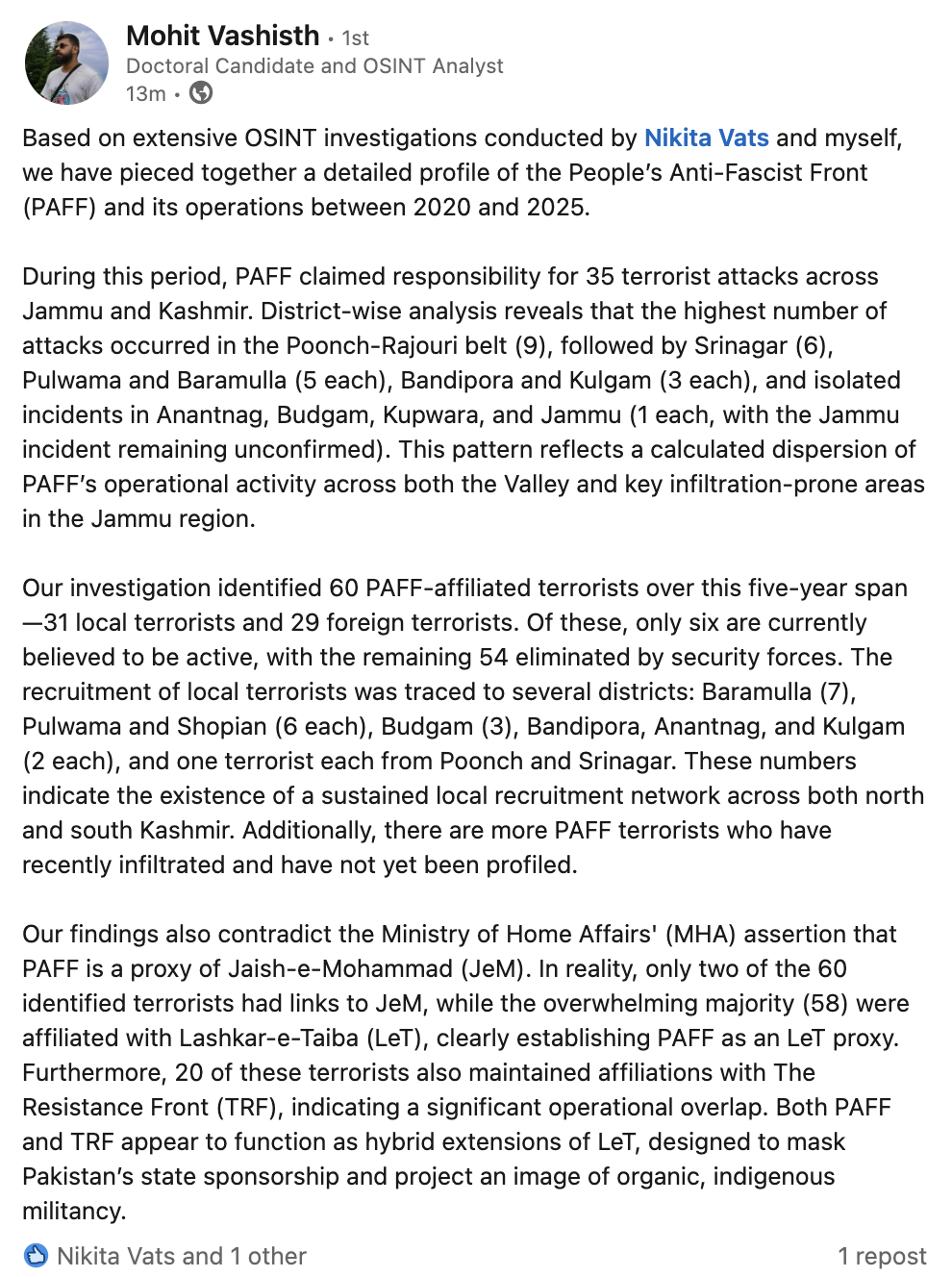
This is a clickable screenshot of Mohit Vashisth’s LinkedIn post
made on June 6, 2025.
Drawing from their open-source intelligence (OSINT) investigations, the researchers claim to have profiled PAFF's operations in Jammu and Kashmir between 2020 and 2025, accounting for 35 terrorist attacks attributed to the group and the recruitment patterns of 60 affiliated militants. The attacks are found to have been concentrated in the Poonch-Rajouri belt (9 attacks), Srinagar (6) as well as Pulwama and Baramulla (5 each). Lesser numbers were recorded in Bandipora, Kulgam, and several other districts.
‘This pattern reflects a calculated dispersion of PAFF’s operational activity across both the Valley and key infiltration-prone areas in the Jammu region’, Vashisth notes in his post.
Of the 60 PAFF-affiliated militants (spanning 5 years) the study identified, 31 are claimed to be local and 29 foreign; however, 54 of these militants have been killed by India’s security forces, Vashisth clarifies. The recruitment of local militants, the study found, was not random but sustained and spanned both north and south Kashmir, with key hotspots including Baramulla, Pulwama, Shopian, and Budgam.
Crucially, the analysis undermines official government assertions regarding PAFF's external affiliations. While only two of the 60 militants were found to be linked to JeM, the overwhelming majority (58) were found to be associated with LeT, per the OSINT investigation. Vashisth also notes ‘a significant operational overlap’ among the terrorists—with 20 of them also having ties to The Resistance Front (TRF).
Inasmuch as ‘PAFF and TRF appear to function as hybrid extensions of LeT’, they seem ‘designed to mask Pakistan’s state sponsorship and project an image of organic, indigenous militancy’, Vashisth concludes.
The study’s findings would be useful to grasping militant group affiliations in the region, amid ongoing debates on cross-border terrorism and local radicalisation narratives. In a June 7 follow-up comment on his post, Vashisth noted that ‘a detailed research paper analysing PAFF's origin, attacks, leadership, cadres and its links with other outfits is on its way.’
As new militant outfits continue to emerge under various banners, such OSINT-led research is increasingly likely to shape counter-terrorism policy grounded in relatively current quantitative data. That, however, also speaks to the need for locating this rather technical approach critically within the context of other approaches and frameworks better suited to study the deeper and long-term causes of terrorism and human factors behind it.
On LinkedIn, Vashisth’s post could be accessed via this link: https://www.linkedin.com/feed/update/urn:li:activity:7336781623947890688/