
World Bank economist launches online repository of publications on Haiti
by Piyush Mathur
A senior economist at the World Bank has launched a free online repository aimed at preventing research on Haiti from disappearing from the Internet.
Around three weeks ago, in February 2026, Bernard Haven announced on LinkedIn the creation of the Haiti Document Repository (HDR), a searchable digital collection of more than 270 published reports about Haiti. The site gathers research across multiple fields including governance, health, economics, education and the environment, with documents available in Kreyòl ayisyen, French and English.
Haven said the idea emerged from a recurring problem he observed while working on Haiti. ‘Over the years working on Haiti, I’ve watched countless reports and research studies get published… and then quietly disappear’, he wrote, noting that broken links, institutional restructuring and organisational closures often cause online documents to vanish.
The repository, available at haitidocs.org, uses Artificial Intelligence (AI) tools to organise and index publications so they remain searchable and accessible. Haven noted that his goal is to ‘make sure the knowledge that already exists stays findable.’ He pointed out that the site already had 274+ documents and includes a submission feature allowing visitors to add additional material.
The initiative prompted instant support on LinkedIn.
Daniel Erwin, a staff product designer at Splunk, said he had added the site to the Internet Archive’s Wayback Machine to ensure it is preserved as part of the archive’s collections.
Freelance consultant Delphine Colbeau praised the project as an ‘excellent initiative’, noting that she had already submitted several documents.
Investment banker and analyst Shakawat Hossain observed that the disappearance of online reports is a broader problem, saying he had seen similar issues while working in Bangladesh, where government websites sometimes lose files or links over time.
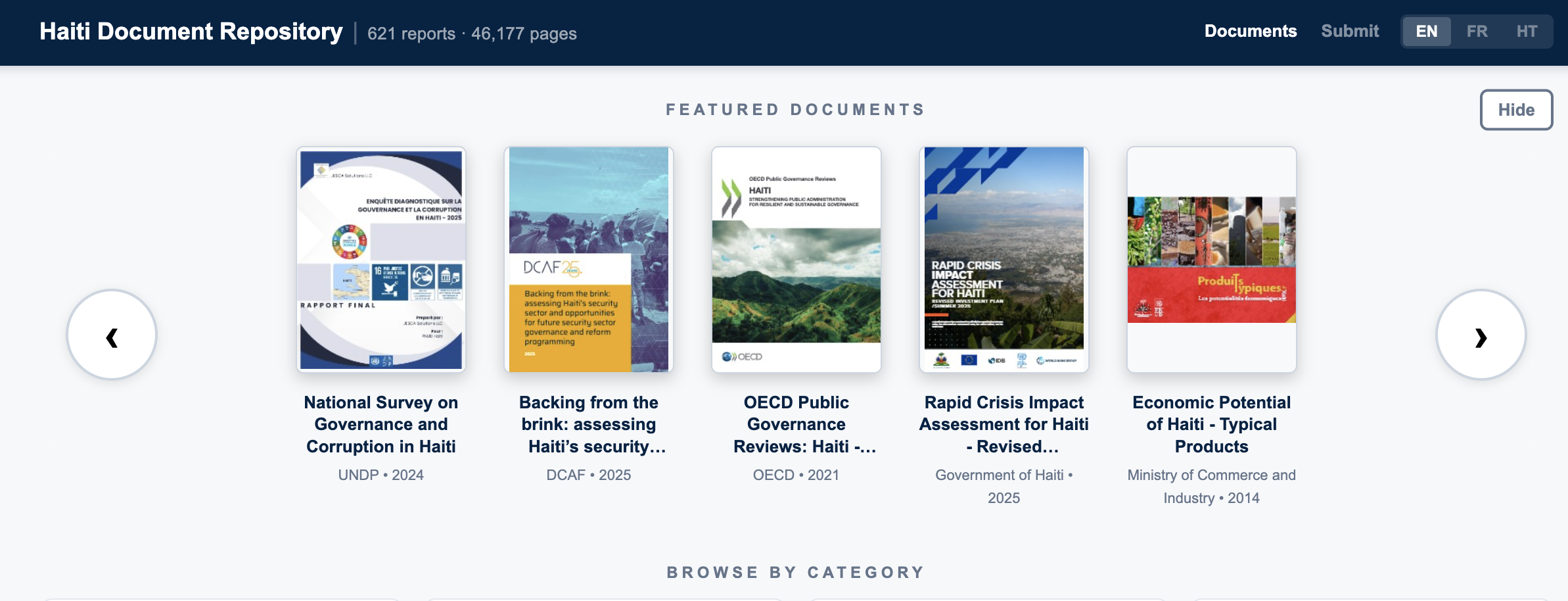
This is a clickable screenshot of a part of the landing page for the Haiti Document Repository’s website, launched by Bernard Haven in February 2026.
(Image credit: Thoughtfox)
Digital preservation has indeed become an increasing worldwide concern for researchers and development professionals, as reports hosted by institutions and governments often become inaccessible after website changes or organisational restructuring. Nor is this issue terribly new.
In a report published in May 2024, the Pew Research Center noted that around ‘38% of webpages that existed in 2013 are not available today, compared with 8% of pages that existed in 2023.’ More than 10 years prior, a report published by Georgetown Law Library and members of the Chesapeake Digital Preservation Group had concluded that ‘nearly 38 percent of online legal reports and web pages’ that the library had preserved had ‘disappeared from their original web addresses’ within 5 years.
Haven’s repository seeks to address this problem—at least for research relating to Haiti—by creating a single, durable point of access for existing knowledge. As on March 11, 2026, HDR hosts 621 reports.
References
Chapekis, Athena; Samuel Bestvater , Emma Remy & Gonzalo Rivero(May 17, 2024) ‘When Online Content Disappears’ Pew Research Center (URL: https://www.pewresearch.org/data-labs/2024/05/17/when-online-content-disappears/)
Haven, Bernard (February 2026) ‘Over the years working on Haiti...’ LinkedIn (URL: https://www.linkedin.com/posts/bernard-haven_over-the-years-working-on-haiti-ive-watched-activity-7428813099094274048-doVQ)
Price, Gary (May 3, 2012) ‘Link Rot: Georgetown Law Library Finds 38 Percent of Online Documents Disappear from Web Pages Within Five Years’ Library Journal (URL: https://www.infodocket.com/2012/05/03/link-rot-georgetown-law-library-finds-38-percent-of-online-documents-disappear-from-web-pages-within-five-years/)