
April 8, 2026: Report on Zimbabwe’s 2023 elections to be launched by the University of Pretoria’s Centre for Human Rights
by Piyush Mathur
Via a webinar, The Centre for Human Rights, University of Pretoria will launch a report on Zimbabwe's August 23, 2023 elections on April 8, 2026.
According to the organisers’ press statement, the event would ‘interrogate the extent to which Zimbabwe's electoral stakeholders complied with the Guidelines on Access to Information and Elections in Africa, adopted by the African Commission on Human and Peoples' Rights in 2017.’
Titled Proactive Disclosure of Information During Elections: An Evaluation of Zimbabwe's Compliance with the Guidelines on Access to Information and Elections in Africa During the Harmonised Elections of 23 August 2023, the report was produced with the collaboration of MISA Zimbabwe.
To attend this 2-hour-long free webinar, one must register for it via this Zoom link:
https://zoom.us/webinar/register/WN_NJM-s4xNTXeYBwCp6QBFOg#/registration
On April 8, this event will start at 11:00 AM SAST.
(That would be, on the same day, 10 AM WAT / 9 AM GMT-UTC / 12 PM EAT/ 2:30 PM IST/ 3 PM MUT / 5 PM CST / 6 PM KST / 5:00 PM AWST / 6:30 PM ACST / 7:00 PM AEST.)
Background
It may be useful to note that Zimbabwe created a harmonised framework for its elections via the Constitution of Zimbabwe Amendment (No. 18) Act, 2007. This framework was operationalised on January 24, 2008 through a Presidential Proclamation (SI 7A/2008) that dissolved the parliament and called elections for the seats of President, Parliament, Senate, and local authorities on the same day, March 29, 2008.
A Presidential Proclamation in Zimbabwe is a Statutory Instrument, or SI, published in the Government Gazette. The image below shows the front page of the Gazette that contained SI 7A/2008—which is also referred to as ‘Proclamation 2 of 2008’ or ‘SI 7A of 2008’; it was issued by President Robert Mugabe.
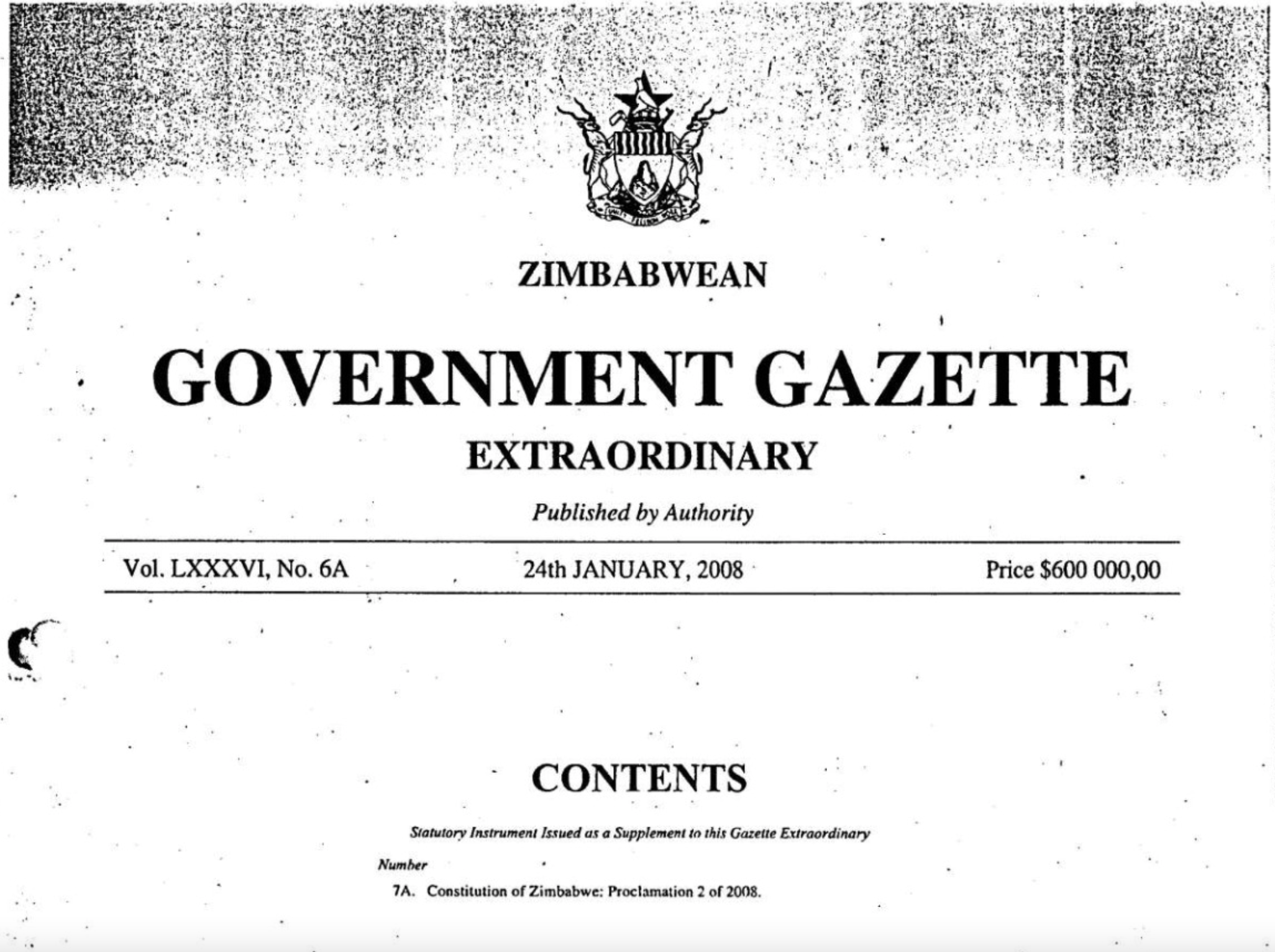
This is a partial image of the front page of the Zimbabwean Government Gazette that carried the presidential proclamation mandating harmonised elections across Zimbabwe. (Image credit: Zimbabwe Legal Information Institute or ZimLII)
Since 2008, Zimbabwe has held three synchronised elections—in 2013, 2018, and 2023. The 2008 elections were held on March 29; the 2013 ones on July 31; the 2018 ones on July 30; and the 2023 ones unfolded on August 23-24.
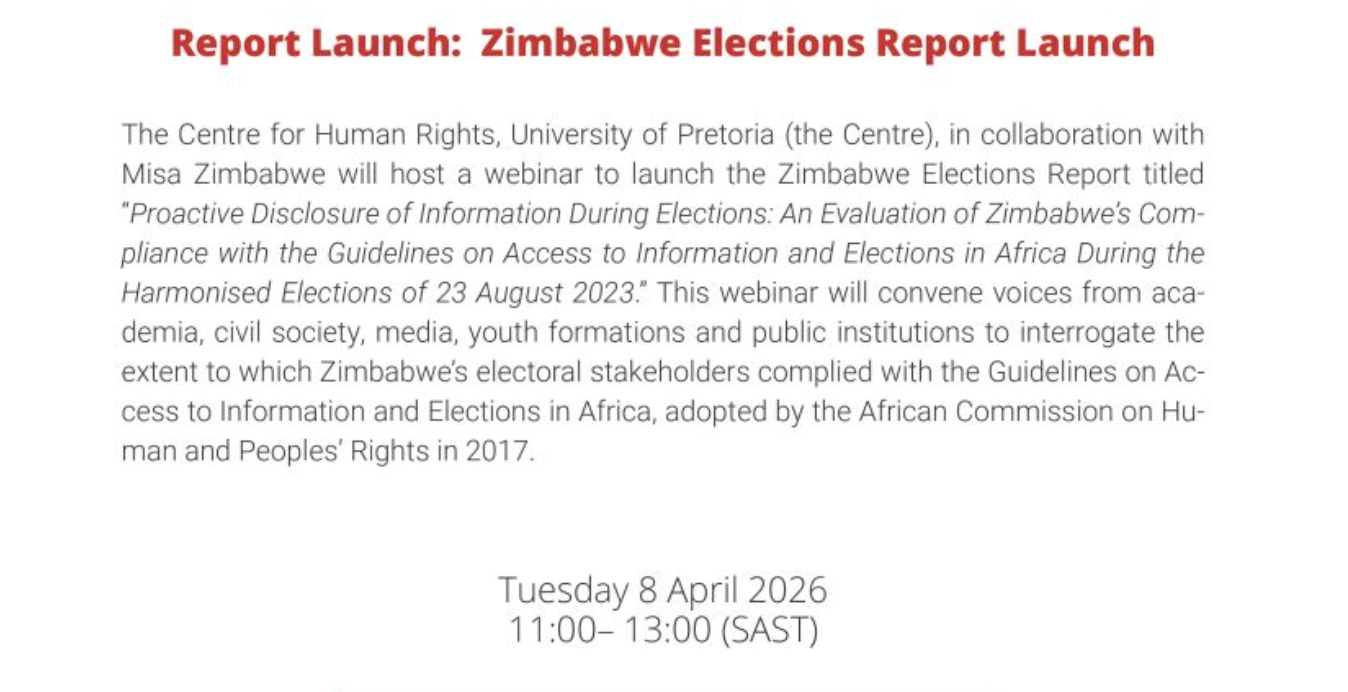
This is a screenshot of one of the press releases digitally circulated by this event’s organisers. (Image credit: The University of Pretoria)
In a previous press release on LinkedIn for another Zoom launch—dated March 12, 2026—of the same report, the Centre for Human Rights had noted that its qualitative research took place ‘between July and October 2023’, and it exposed ‘significant gaps in proactive disclosure by key electoral stakeholders during Zimbabwe’s 23 August 2023 harmonised elections.’ This March launch however did not apparently take place, and the event had to be postponed to the current new date of April 8, according to the Centre’s response to this writer’s query made publicly on LinkedIn in late March.
Other reports on Zimbabwe’s 2023 elections have already been published by the Zimbabwe Electoral Commission (ZEC), the Zimbabwe Gender Commission (ZGC), the Zimbabwe Human Rights Commission, The Carter Center, the European Union Election Observation Mission (EU-EOM), and the Electoral Commissions Forum of SADC Countries (ECF-SADC).

Piyush Mathur, PhD, is a member of Internet Society. See also ‘At Africa’s (political) institutions, aspiring women face informal traps’