
Amazon India’s ‘Pink/Red dot’ tape rollout is confusing at best
by Piyush Mathur
Amazon India recently rolled out an anti-tampering measure for its packages across the country; however, neither the manner of this rollout nor its end-point implementation makes much sense.
While the designers and engineers of this measure may well know or claim to know the precise scope of what they have put together in the name of this measure, what the customer or the package recipient sees is a white tape stuck on to a given package—with the following (poorly worded) instruction printed on it:
If a Pink/Red dot (…like this) appears anywhere on this Label/Seal, please do not accept it.
In place of the parenthetical ellipses in the above typescript, the actual instruction on the tape displays a big magenta dot—which one can see in the image below:
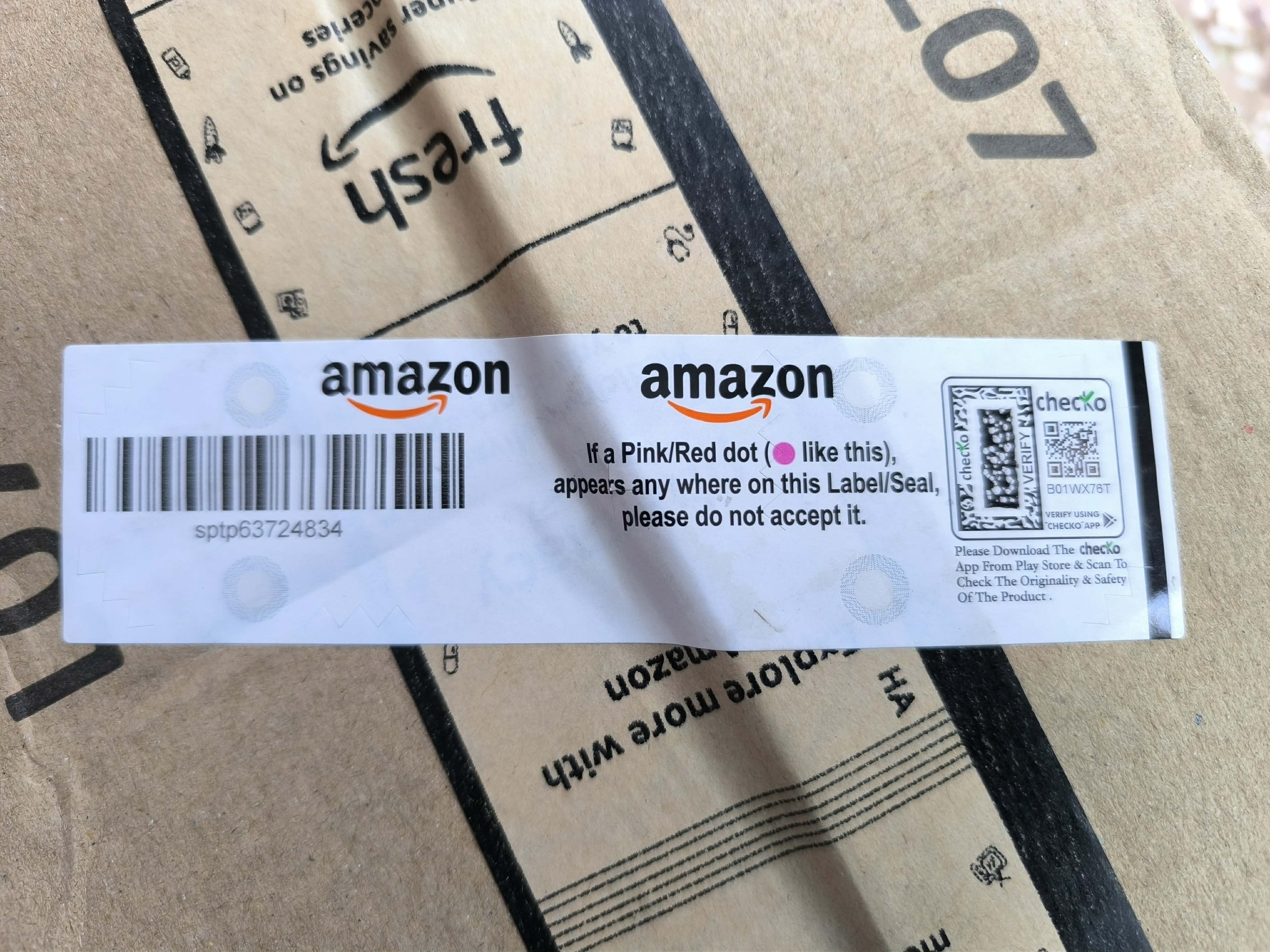
This is a screenshot of Amazon India’s poorly worded, English-only warning tape found on random packages’ random places. (Image credit: Thoughtfox)
It should not have been difficult to imagine—as it apparently has been for Amazon India’s executives—that the presence of such a big magenta dot (albeit referred to as red or pink) in the instruction itself is apt to confuse the package’s recipient, who is supposed to return the package upon seeing such a dot ‘anywhere on this Label/Seal’, per the instruction’s own language!
Nor does it help anybody that the instruction has an ungrammatical syntax. From the given sentence, the only correct message that is conveyed to the reader also happens to be a rather absurd one. What the sentence means is that one should not accept the ‘Label/Seal’ itself (rather than the package displaying it) if it happens to retain ‘a Pink/Red dot’. The word ‘it’ in that sentence has only one visible antecedent: ‘this Label/Seal’, and not the package.
Well, does it further help Amazon India’s case that the P of Pink, the R of Red, the first L of Label, and the S of Seal have been arbitrarily capitalised in that sentence? No, it does not! While this practice of arbitrary capitalisation seems to suit the sitting American president, it only ends up undercutting Amazon India’s credibility when it comes to this particular instance of labelling—precisely when the company needs to reassure its customers of its own communications’ authenticity as well as the safety and security of its deliveries to them. Poor grammar and punctuation are typically associated with scammers.
Amazon India’s aggressive self-promotion versus convenient silences
There is of course more to these clusters of missteps on the part of Amazon India: a company that has been exploiting every single opportunity to push its Prime Membership (PM) to its customers, including by refusing to give them the option to turn off its PM push notification. This PM push notification happens to be a default large banner that the customer has to manually respond to before being able to make a payment each time for a new order.
But Amazon India is also a company that surreptitiously adds its messaging services to its customers’ Whatsapp accounts without even seeking their permission: The customer is also not told personally (or via a mass email or phone text message) about the option to unsubscribe from this unsolicited Whatsapp outreach (though the company cleverly mentions that type of an option on its sprawling website).
That the Indian customer does not typically resist these coercive and unethical corporate incursions tells you a lot about the state of consumer and privacy rights in India, even though Amazon India’s executive may prefer to see it as some kind of smart marketing on their part.
But, here is the thing: For a company that has been unbearably intrusive in its advertising and marketing, all acts of silences would also have to be open targets for fair scrutiny, never mind that India’s elite media tends to keep quiet, suspending all its expected criticality, when it comes to such corporate acts (and surely worse).
One such act of effective silence on the part of Amazon India was when, in mid-2025, it introduced the per-order ‘Marketplace Fee’ of INR 5. The vast majority of customers came to know of it for the first time when they were about to pay for their first orders carrying that fee. Although the customer did not really understand what that fee was really about, (s)he did not mind paying it—because the amount was so small and there were no alternatives, given that most major e-commerce platforms in India would introduce similar fees around the same time.
As far as Amazon India was concerned, it never sent one of those mass messages to its registered customers regarding an imminent ‘marketplace fee’; nor did it put out some unavoidable large banner, like the PM one, notifying the customer of this new fee on the payment window. The company simply took the Indian customer for granted by including the fee in the list of overall charges per order.
Now, the company did post an explainer about that fee on its website. There is just one problem with that explainer: It explains nothing! Here is what the explainer—last updated on June 3, 2025—says about that fee:
‘Amazon.in’s marketplace fee is a flat fee charged by Amazon to customers. It enables Amazon to offer a vast range of products from millions of sellers.’
In simpler terms, the company might as well have said this to its customers: It is our way or highway, toddlers!
In point of fact, Amazon India’s so-called ‘Marketplace Fee’ is nothing if not an ‘Oligopoly Levy’ passed on to the Indian customer, who is never asked to pay any such fee by a corner shop (which is also typically not part of an oligopolistic market network).
So, where does that leave us with the 'Pink/Red dot’ tape?
Amazon India did not lead any type of media campaign regarding its relatively recent anti-tampering measure, even though campaign like that—especially if created ahead of the measure’s implementation—would have been crucial to reassuring the customer of its sheer authenticity. Nor did the company send out any messages internally to its registered customers that they should expect such a measure after a given date.
Predictably, the measure caught the customers off guard—which is evident from the social media chatter about it. This chatter has been rather scant so far, indicating that most customers have basically ignored this ineffective and arbitrary paper gimmick.
That the customers were not only caught off guard but were also left largely clueless about the substance of this measure is also evident from the fact that there are all sorts of speculations, within the scant social media chatter, about the measure’s scope and functionality.
Although a June 03, 2025 report filed for India TV News by Om Gupta reads entirely optimistic and confident about this measure—declaring that it would make ‘tampering with packages…nearly impossible’—it offers little beyond fluff and guesswork.
Early on, referring to those so-called pink/red dots, this report makes the following exhortation to Amazon India customers: ‘If you receive a product from Amazon, be sure to inspect the packaging for these distinct markings.’ This should surely alert the report’s reader to check for those dots on all Amazon India packages; however, the report unwittingly contradicts itself further down the line by noting that the measure has so far been ‘employed for Amazon’s pharmaceutical products’.
Weird arbitrariness of the label’s usage
Nevertheless, soon after Gupta’s report’s publication, a Redditor noted that the measure was intended to protect ‘high value items’—except that this assertion itself was also quickly contradicted by another Redditor, v00123, who mentioned that his/her package containing Surf liquid ‘had the same strip’.
As to how this measure works and why it may have been implemented, Gupta writes—without providing any evidence—that it is meant to outsmart scamming ‘delivery agents’ who ‘heat the seals on packages, swap the contents, and reseal them, making it nearly impossible for the customer or the platform to detect the tampering.’ Elsewhere in the report, Gupta adds the following: ‘If someone tries to remove this tape using heat, the colour of the dot changes, providing a clear indication of tampering.’
However, in that Reddit thread cited above, there is enough speculation that the dots are ‘humidity’ or ‘moisture’ (rather than heat) sensitive.
But as for either heat or moisture, can any sane engineer or designer claim that a tape on the surface of a package covering distances across India won’t be exposed to some extra heat or a bit of moisture? Who is to determine whether the introduced heat or moisture—if either of these actually be a factor—is necessarily tied to malicious tampering? Quite obviously, Amazon India is not trying to determine that crucial part, per se, by taking recourse to this type of a measure.
It gets worse. This writer himself has received a package that had that tape placed smack on the middle of a side of the package, not anywhere near its standard seal—though one should expect that an alleged anti-tamper tape would be placed on top of the standard package seal somewhere.
Nor was this part left out by Redditors around 7 months ago when they began discussing this new initiative that had caught them by surprise.
One Redditor, OtherwisePossible330, highlighted the random placement of this allegedly anti-tampering tape on Amazon India’s packages—noting that ‘they are putting it anywhere.’ This Redditor argued that the company had ‘good intentions but not properly implemented.’

This is a screenshot of a comment made on the Reddit platform around June 2025. (Image credit: Thoughtfox)
Indeed, even the Reddit thread carrying the above comment started out with an image that shows the tape placed apparently on the side of the box, clearly away from the standard seal:
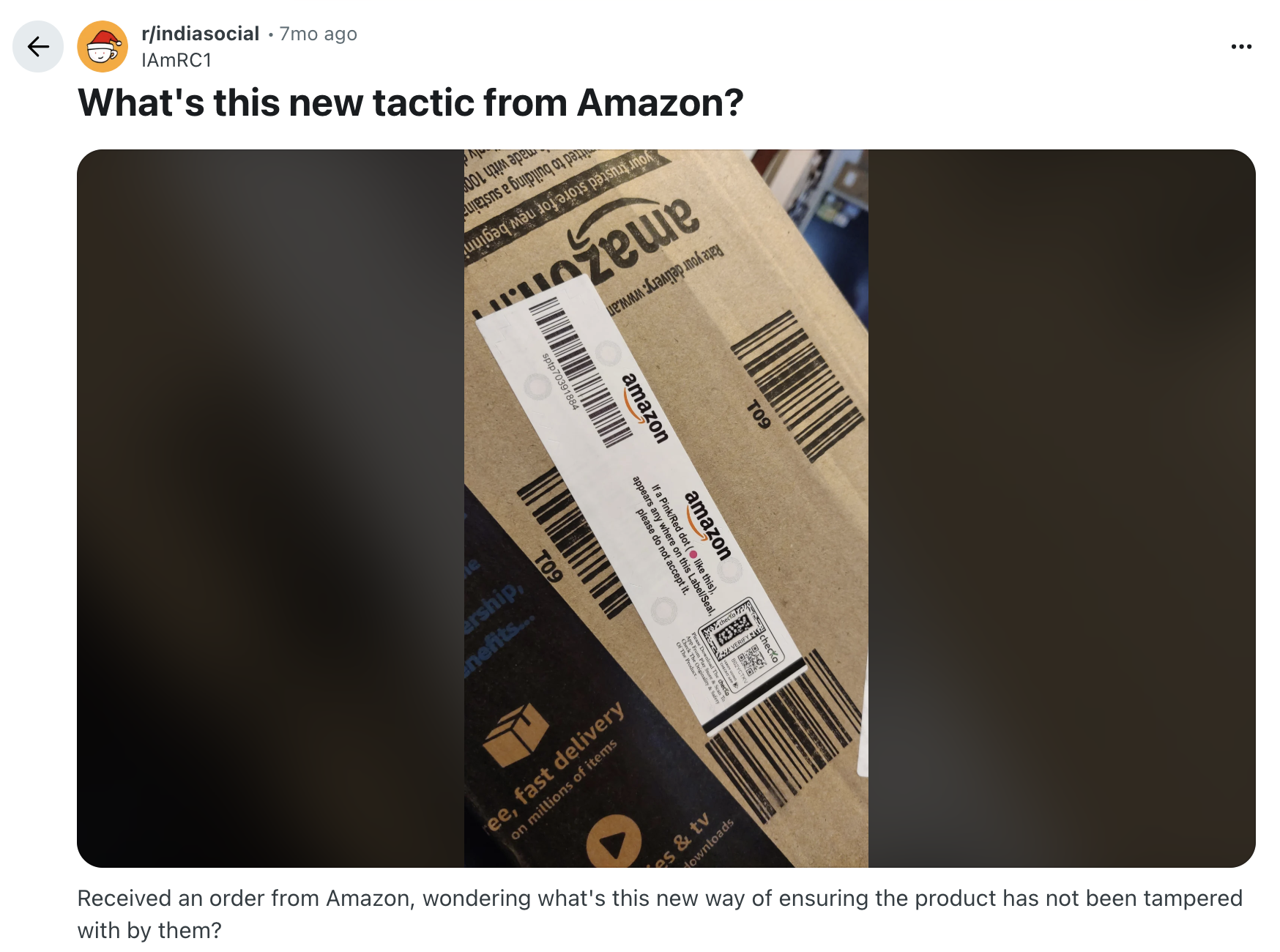
This is a screenshot of a post made on the Reddit platform around June 2025. (Image credit: Thoughtfox)
But, does a pink or red dot (which is anyway represented by a magenta one on Amazon India’s tape) actually indicate that the contents of a received parcel are counterfeit or damaged or replaced? Of course, it does not!
Not only that these silly dots will come into their colour owing to atmospheric or random factors unrelated to what may have happened to package’s contents, but also that Amazon India’s own awful instruction inscribed on the tape makes no mention of a connection between their display of a colour and the integrity of the package’s contents. All it does is to make the recipient of the package sweat a bit—and return the package if any of those dots are found to be showing a pink/red (but really magenta?) shade. This is just shifting the responsibility of a package’s integrity on to the customer, who is not promised any discount or award anyway for delaying what is due to him or her by returning the order.
It is amusing, however, how confidently naive consumers can be. In a November 29, 2025 post on X, one individual cheerled Amazon India on this score by showing a photo of what looks like an unopened box whose anti-tampering tape he had subjected to some extra heat; the blank/white blobs had begun to show a faint magenta hue following his little experimentation. To this person (whose post’s screenshot is provided below), this was evidence that Amazon India’s innovative measure was effective. Unfortunately, though, the contents of his package had remained unharmed, of course—and that itself should have illustrated to him that these dots’ colours are pretty useless when it comes to indicating the integrity of a delivered package’s contents.
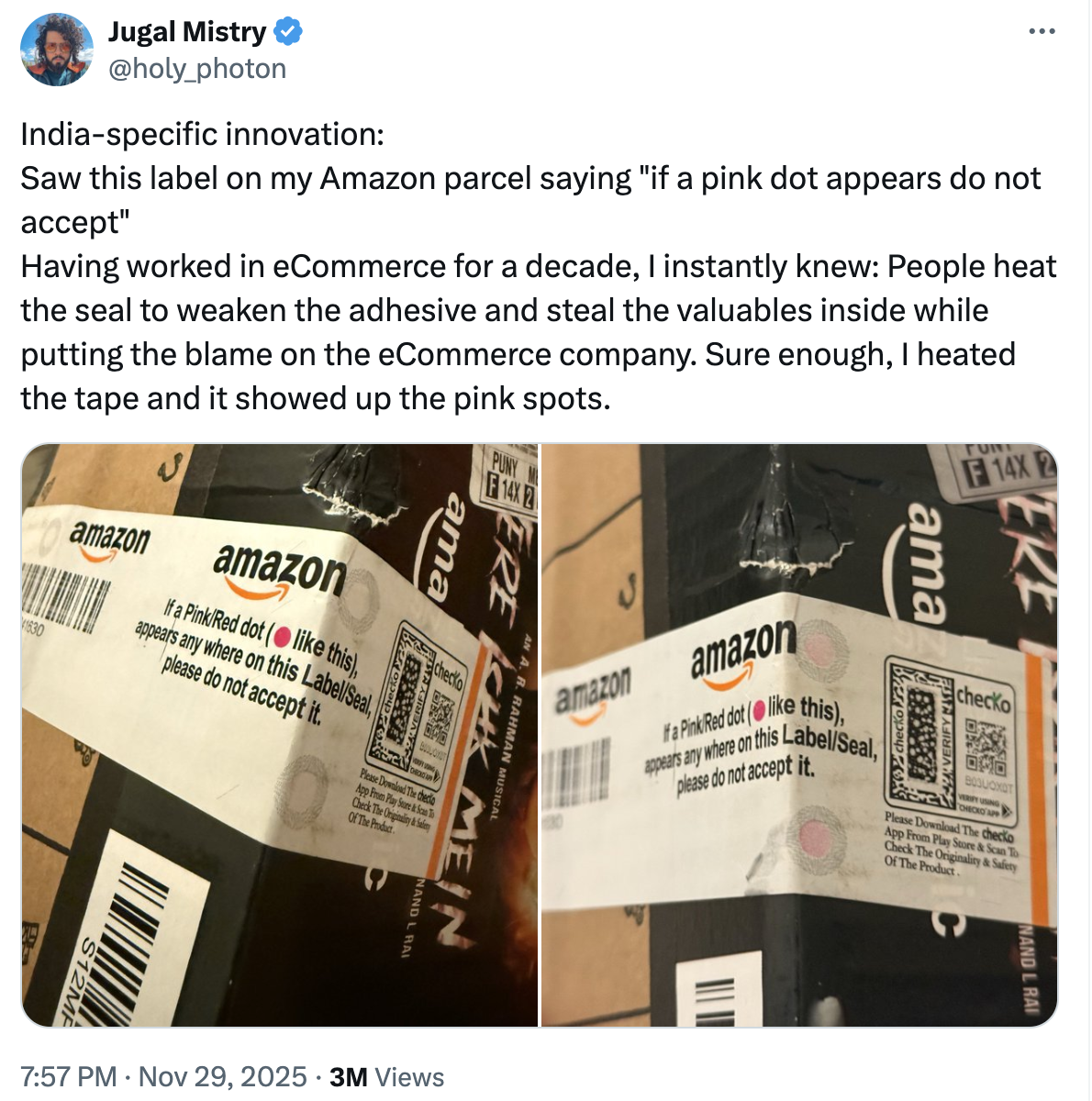
This is a clickable screenshot of a post made to X on November 29, 2025. (Image credit: Thoughtfox)
But what if that dotted alarm seal itself is torn off?
Inasmuch as Amazon India never took care to use its messaging systems to inform its customers about this peculiar measure, it also did not convey to them a Plan B (or C or D) regarding the same. Aside from all sorts of external situations that could bring about the magenta inside these whitish/empty dots—which are otherwise not easily noticeable—what with an already coloured dot hogging the limelight in the instruction—there would have been one easiest possibility that the executives never considered: that this alarming tape itself could be torn off fairly easily (and given the arbitrary nature of its employment, a customer won’t even notice the tear, given that boxes frequently arrive with some superficial tear anyway).
This writer himself received a box whose dotted alarm tape was partially torn—making it difficult to read, let alone interpret, the instruction it had on it (See the image below.) Mistaking the bright dot itself as one of those dots that were supposed to indicate some type of a danger—which is not specified in the instruction anyway—the writer wondered about it to Amazon India associates via chat; many of them were themselves unaware of this measure, and did not know what advice to give the writer. Eventually, the writer had to arrange for the package’s return.
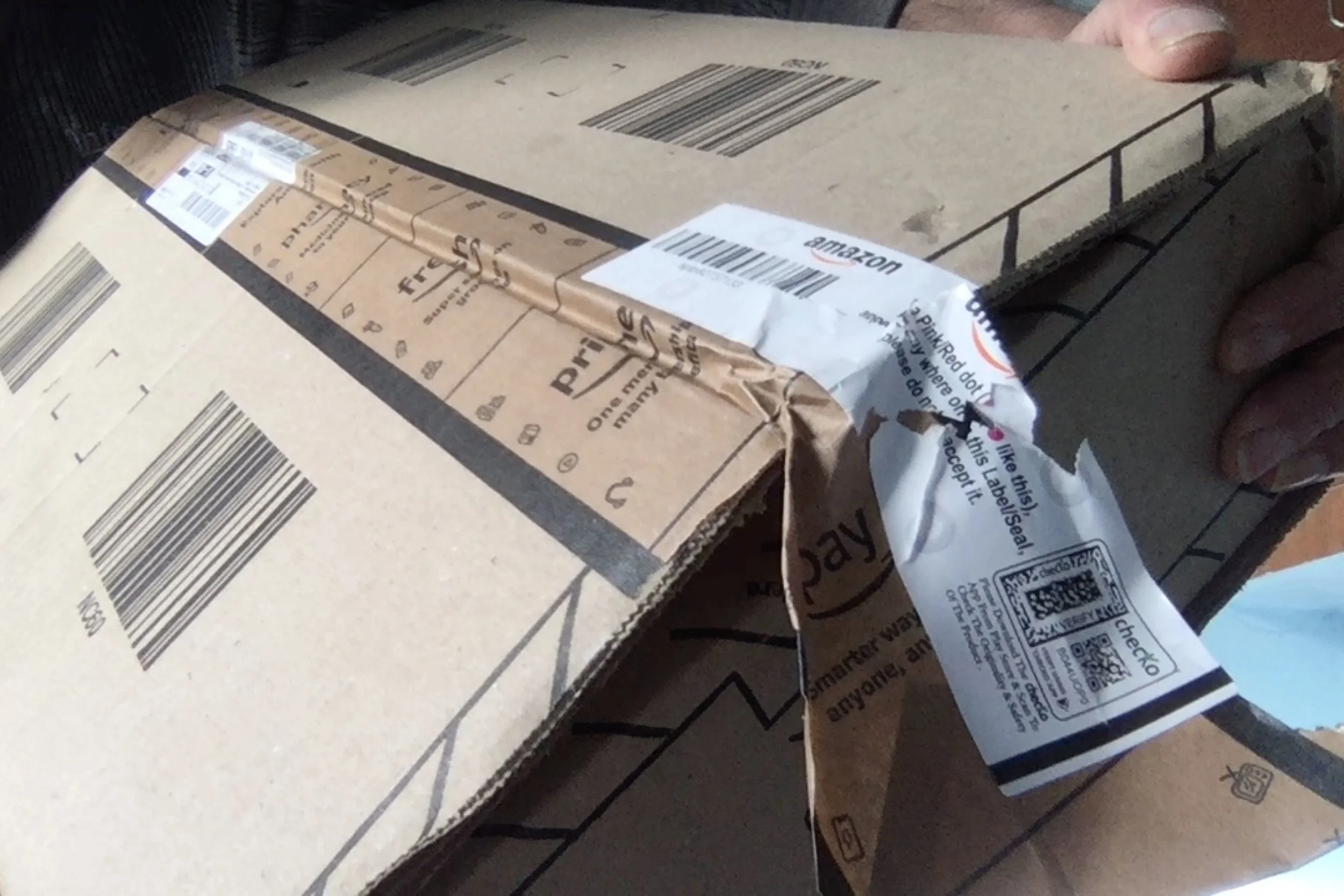
This is a photograph of an Amazon India package received with its dotted alarm tape partially asunder. (Image credit: Piyush Mathur)
However, taking a second look at the merchant’s reputation—which was stellar—and at the box itself, which seemed perfectly secure, the writer decided to open the box anyway, and found the ordered electronic item inside it to be perfectly valid. Soon thereafter, the writer noticed the actual empty/white dots that were supposed to be coloured if the box had been tampered somehow!
But to remind the reader, the tape itself had been torn up quite a bit. So, there!
Concluding words
Now, if Amazon India is willing to invest in safeguarding its parcels, then it should invest in putting together its own end-to-end fleet of air-conditioned, camera-monitored vehicles, along with an adequate staff of full-time handlers, all the way through. That is the only way the company could own the responsibility for safe deliveries. As for this dotted alarm belt, it is not only useless but also counter-productive from the customer’s viewpoint.
Finally, the company must also start putting out its on-package messages in Indian languages other than English if it is at all serious about the situation on the ground.