
Review of Shlomo Cohen’s book on ‘manipulation’
by Christopher Giofreda
Everyone is exposed to manipulation daily, and everyone manipulates too. The impact of manipulations in person, social, and political life is enormous. Is this tragic? Is it avoidable? Is it always morally bad or regrettable? To answer these questions, we need a theory of manipulation—and we find one in Shlomo Cohen’s Concept and ethics of manipulation. Published last month by the Cambridge University Press, the book locates manipulation at the intersection of philosophy and behavioural psychology, distinguishes it from other kinds of influence, and assesses its moral status.
Cohen—who teaches Philosophy at Ben-Gurion University of the Negev—puts forward the basic argument that rational persuasion (RP) is forever enmeshed with non-argumentative influence (NAI), comprising non-rational techniques that involve manipulation (e.g., touching someone on the arm for emphasis). The removal of all manipulation, he writes, is not only chimeric but unwelcome. We could posit a world of only RP—a deliberative utopia where facts are indubitable—but we would already have a conceptual problem: Arguing rightly in the past is not sufficient to prove that you will argue well in the future. Moreover, in an RP utopia, the brand of the wise teacher, expert, or consultant, could not exist in a recognizable form—and nor would we be able to reject the interviewee who showed up wearing rags!
Cohen argues well for a base layer of non-argumentative influence through which we employ reason. He wants to understand this manipulation that cannot be helped, and ask about its ethical status. Of course, the fact that manipulation cannot be helped says something about our responsibility for it—and he offers a deeper understanding of the ethics of the interplay between reason and power in human relations. While the book doesn’t mention the German philosopher Jürgen Habermas until near the end, his spirit permeates it.
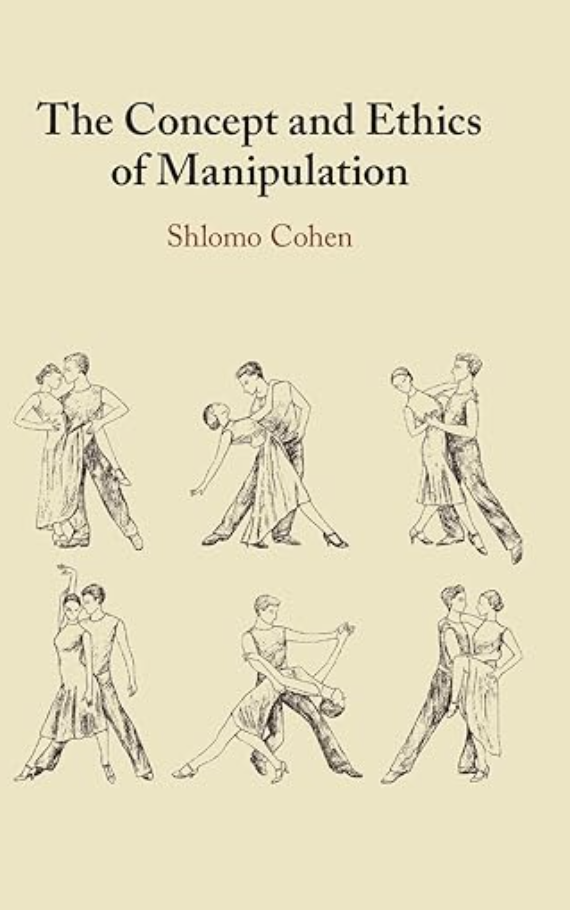
This is a screenshot of Sclomo Cohen’s book’s cover image.
Deeper matters—and a critical overview, chapter-by-chapter
For Plato’s Socrates, manipulation and flattery damaged one’s own soul—and only RP could help one repair this error; Cohen’s NAI, however, makes this process hard or impossible. Readers will thus find productive tension between Cohen’s all-encompassing view of manipulation and the Socratic dialectical system. Some scholars, especially rhetoricians, will find Cohen’s position to be a relief: They don’t have to blame Aristotle for including emotional management in the Rhetoric—or feel guilty studying behavioural psychology! Other readers will see their idols torn down, e.g., Cohen is confident that Plato’s Socrates himself is a sophist or ‘arch-manipulator’ (54). Ultimately, Cohen may be correct that we cannot always expect to generate full agreement through rationality or to avoid some NAI.
If Aristotle’s motives are to be believed, and if Cohen finds his Rhetoric manipulative anyway, then ‘manipulation’ covers things like research. This is not a gap so much as a point of interest. Indeed, if I know that you will influence me, shall I do more homework than you to resist this and, most likely, shift your own psychology? Is this manipulative? Cohen opens the door to think this way. In any case, Aristotle admits that rhetoric—like anything except virtue—can be abused.
The concept and ethics of manipulation has two parts of three chapters each. The first part establishes paradigmatic images of manipulation as well as associated ‘clusters’ to catch manipulation in the wild. Cohen offers vivid examples, which make the rather lengthy setup easy to navigate. The book’s second half contemplates the implications of what he finds. Cohen is nonplussed by the pervasiveness of manipulation, whose role as a ubiquitous social lubricant makes it difficult to be regarded as tragic.
Chapter One, ‘An Elusive Concept’, is definitional. Cohen carves up the term ‘influence’ into edible slices, lest it overwhelm. He first divides influential actions into the manipulative and non-manipulative. In the latter category—left a bit mysterious—we can class those actions that seem manipulative but aren’t. My example would be Anna, who normally dresses conservatively but finds that her only clean garment is a rather revealing gift from a friend. Anna wears it out of the house, yet passersby hoot and holler that she just wants to get attention. Someone is manipulated, but not through an action for which Anna is responsible.
The second of Cohen’s dialectic divisions is between two types of ordinary manipulations: one represented by the orthopedic adjustment; the other that influences fellow humans psychologically (6). In the latter category, which is his focus, Cohen places hyperbole, code words, flattery, impressing, irrelevancy, and a rather large host of other foul play. Psychological manipulation is differentiated from an ordinary type of influential action. For example, when a truant is brought back to school by a welfare officer, the truant has usually been manipulated both physically and psychologically.
Chapter Two, ‘Manipulation as Conceptual Metaphor’, describes RP and NAI. RP is about making a good argument and getting assent; NAI refers to various techniques that lie outside of argument (e.g., presenting good alternatives at the middle and end of a list). Pure RP, for Cohen, exists only in unusual circumstances: It is largely theoretical.
But we don’t yet know how much NAI has to exist to call an act manipulative. Cohen prefers to judge the balance between NAI and RP in an exchange. He argues against two purist definitions where 1) even a little RP rules out manipulation or 2) full RP is needed to exclude manipulation. Noting that communication models presuppose ‘that the parties are communicating’, he points out that RP cannot really get you into an exchange (or out of one).
One can initiate a conversation with another only ‘through capturing the other’s attention, which makes use of endless NAI techniques’ (45). This observed state of affairs does restrict the purist position to scholarly conferences and not much more (and even then, a paper can be written in such a way as to provoke the participants to focus on the author/presenter in Q & A). Most arguments, for Cohen, come with framing that shapes the rationality inside of them.
Chapter Three, ‘Manipulation: The Anatomy’, argues that ‘manipulation’ is best seen as a cluster of attributes. There are only ‘family resemblances’ among manipulative instances—what Wittgenstein described as ‘a complicated network of similarities overlapping and criss-crossing’ (80). There can be no necessary and sufficient conditions for the term ‘manipulation,’ and Cohen’s descriptive clusters show a keen eye.
The clusters include quantity and quality of intention; soft power; exploiting vulnerability; bypassing and/or subverting rational control; level of transparency; efficacy; level of beneficence; respect for agency; and baseline expectation of influence (e.g., we expect that a timeshare salesman is manipulative, but he or she may still surprise us for good or ill). These criteria are meant to be integrated with our perceptual judgment (114). However, Cohen keeps these qualities discrete rather than assembling them into common groups for our ease of use.
Chapter Four, ‘The Moral Status of Manipulation’, starts out with a reflection on the implications of the earlier chapters. Cohen shows here that NAI can be aligned with duties. For example, one duty of a personal trainer is to thwart your will when you do not wish to hit the gym or maintain your diet. Hiring a gym trainer is to enter into a game of beneficent manipulation. For Cohen, NAI, given the expanse of its scope, is not intrinsically bad; if we disagreed with it, then we might have to forbid most ordinary activities.
Ergo, even the most conscientious would find it futile to treat Cohen’s idea of ‘manipulation’ as a moral code. But there is no apparent need to make an attempt in that direction, either—given that in rhetoric there is space for speech to be rational and influential at the same time. NAI has no space for form and no golden age of practice. People still read Gorgias the rhetorician because his NAI rose to art.
Chapter Five, ‘Manipulation and Respect for Persons’, argues that manipulation does not, in the main, disrespect human persons. Cohen believes that people have a hypothetical syllogism constructed thus: 1) Manipulation exercises power, 2) Power manifests superiority, 3) Superiority is the opposite of treating people equally, 4) This portends disrespect, 5) Manipulation disrespects persons. Finding fault in such reasoning, he points out that the paradigmatic case of disrespect—i.e., objectifying people—may not even be manipulative; contrariwise, he shows that Martha Nussbaum’s criteria for objectification do not have to be present to have manipulation.
But, is objectification truly the paradigmatic case of disrespect, as Cohen suggests? One can hardly be sure. For example, American federal agencies abide by a Value of a Statistical Life (VSL) standard—around ten million dollars—when deciding whom to save from disaster. Such objectification prevents disrespect due to class, status, etc.
Chapter Six, ‘On Manipulation in Politics’ explores the theoretical possibility of deliberative democracy against the seeming likelihood of political manipulation. Following his cluster theory of manipulation—applied here to various political practices—Cohen concludes that we are trapped in NAI. The politician, who acts both as a policy advocate and a campaigner, would be a failure if (s)he could not nudge the public to care. More broadly, the very concept of a democratic compromise is, after all, dependent on NAI in the form of constructing an initial position.
Cohen shrinks the domain of RP whether we are talking about campaigning, securing engagement, negotiating, ruling, or stabilizing one’s rule. The chapter is clear in its stakes, though the objective is largely accomplished in the book’s first half.
Conclusion
The concept and ethics of manipulation is like tearing down a community centre to build a bottling plant: You can agree with its thesis only in a pessimistic register. That said, Cohen is right that persuasion is always close to going too far.
There is a moment in every rhetoric class where the instructor has to decide how much to teach. Should students opt to win via spectacle when they would surely lose via reason? Opening with Plato’s Gorgias confirms what we know of ourselves—and Cohen knows it too: Each of us follows the sage and the sophist by turns. (Hopefully we do not lose track of ourselves or conflate the types.)
But one wonders, after reading Cohen, how often the decisions are themselves unconscious. Are we manipulated to be manipulators, by ourselves to ourselves? We must respect any book that leads to such questions. Cohen is quite mordant. His book is one for our time, a rough and tumble era without an aspirational character.
N.B. Cohen’s ‘family resemblances’ might have included the paradigmatic case of manipulation in modern media. The excursus can be found here.
Work cited
Cohen, Shlomo (2025) The concept and ethics of manipulation (Cambridge University Press) (ISBN-10: 1009443445; ISBN-13: 978-1009443449)

Second reader and copyeditor: Dr. Piyush Mathur
