
Software engineer announces digital project on the Thirukkural
by Piyush Mathur
Software engineer Dhandayudapani D.—whose LinkedIn profile claims that he works with Dell Technologies—has announced an early-stage digital project of his own aimed at making the Tamil classic Thirukkural more accessible to readers worldwide.
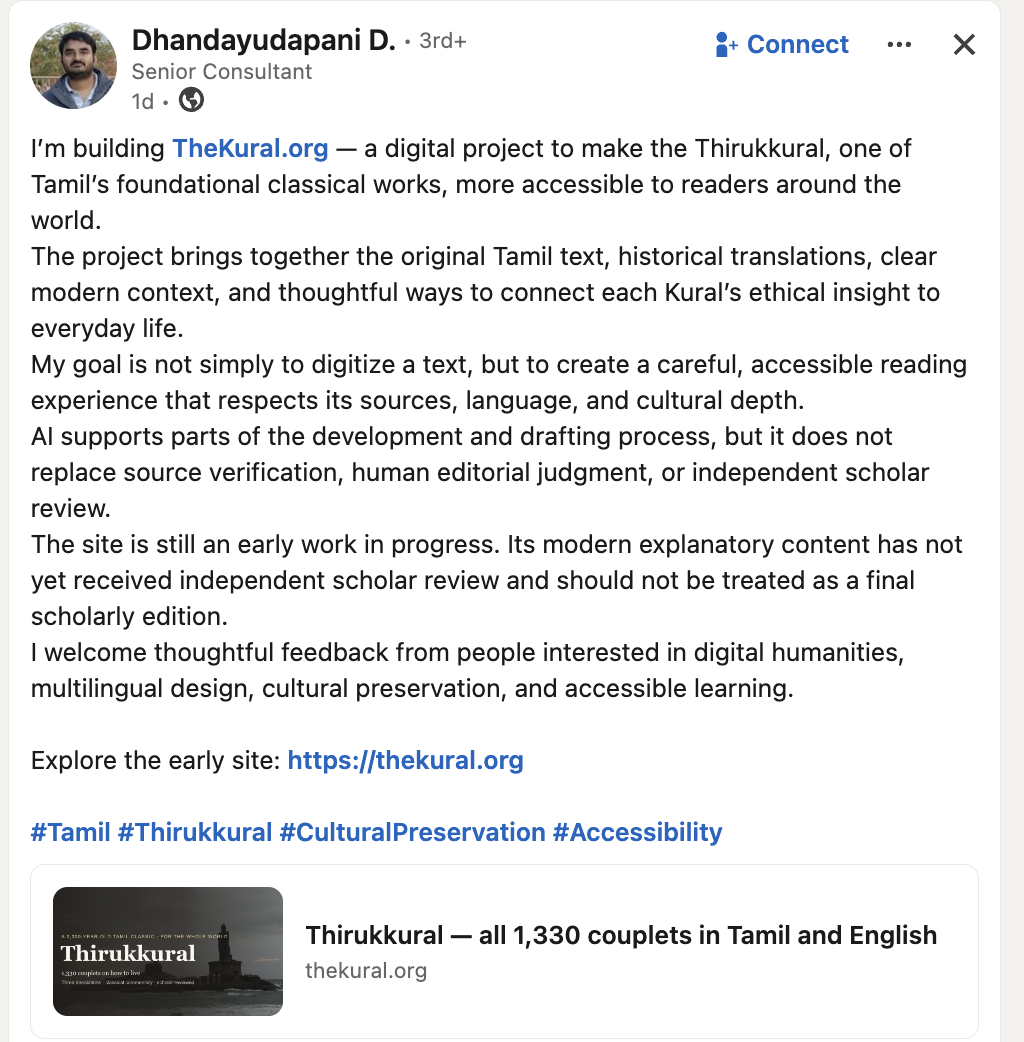
This is a screenshot of Dhandayundapani D’s LinkedIn announcement dated September 14, 2026. (Screenshot credit: Thoughtfox)
Located at TheKural.org, the project brings together the original Tamil text of Thirukkural, its historical translations, and contemporary explanatory material related to it.
Dhandayudapani writes that the intention behind this project—also titled ‘Thirukkural’—is not merely to digitise the 2,000-year-old classical work, ‘but to create a careful and accessible reading experience’ that thoroughly preserves its scholarly, linguistic, and cultural contexts.
The site claims to present in Tamil and English all 1,330 couplets originally authored in Old Tamil by the great poet-philosopher Thiruvalluvar (who has been historically known—and continues to be known—by many other names as well).
Dhandayudapani is explicit about his project's limitations: He notes that AI is being used to assist with ‘parts of the development and drafting process’. However, he adds that humans have been (and will continue to be) responsible for ‘source verification’, ‘editorial judgement’, and external scholarly review.
The post cautions that the site's ‘modern explanatory content’ is still going through scholarly review and is thus not yet ‘a final scholarly edition’.
The LinkedIn responses to Dhandayudapani’s post suggest that the idea has generated both encouragement and practical suggestions. One commenter asked whether an app or login system could eventually track a reader's progress. Another suggested adding more language options beyond English.
In a follow-up comment, Dhandayudapani noted that the project’s site does not so far have ‘accounts, logins, or server-side tracking’ owing to privacy concerns; however, readers can save their ‘favourite Kurals’ on their own browsers, and that won’t be tracked by the project’s website. He also noted that he ‘may explore privacy-first progress features and an iOS/Android app in the future.’ In another follow-up comment, he mentioned that ‘multilingual support’ for the project is under development, and clearly labelled Google Flash AI translations in various languages will be made available down the line.
Other responses focussed on the site's presentational aspects. One reader suggested that a stronger colour contrast and a more readable typeface be used, while another wondered how TheKural.org differs from existing Thirukkural websites and apps, specifically mentioning Thirukural.ai. (It may be noted here that the contrast between the two sites is obvious, with the latter one being quite basic and apparently entirely dependent on an AI-powered search box for asking questions and receiving answers about the classic; Dhandayudapani’s project, on the other hand, is far more ambitious and sophisticated already, in its current, early stage.)
Yet another commenter offered to collaborate by contributing comparisons with other classical works such as Bhartṛhari’s Niti Shatakam and Patanjali’s Yoga Darshana. For now, however, Dhandayudapani is positioning TheKural.org as a work in progress and inviting ‘feedback from people interested in digital humanities, multilingual design, cultural preservation and accessible learning.’ Notably, the project’s website makes the following assertion: ‘Every couplet published here carries the Tamil and its sound, two classic English translations, Parimelazhagar's commentary, and a plain modern reading anyone can follow.’
Made on September 14, 2026, Dhandayudapani’s post—whose screenshot is included in this report—can be accessed on the following Unique Resource Locator (URL): https://lnkd.in/p/g9Jms_Qv