
PhD applicants to Nelson Mandela School of Public Governance frustrated by contradictory admissions information
by Piyush Mathur
A PhD application can require weeks of preparation: refining a research idea, preparing a concept note, updating a CV, gathering transcripts and thinking carefully about whether a prospective supervisor and institution are the right fit. For one prospective applicant to the Nelson Mandela School of Public Governance (NMSPG) at the University of Cape Town (UCT), that effort ended with an unexpected response: NMSPG said it was not accepting PhD applications at all.
An email received by the applicant, seen by Thoughtfox, states that admissions to the PhD programme are ‘currently under a moratorium’ and that NMSPG was therefore ‘unable to consider new applications at this time.’ The email, whose screenshot is included in this report, adds that when admissions reopen, NMSPG will advertise ‘a limited number of PhD positions in specific research areas or topics’, and advises prospective applicants to monitor its website.
The problem is that NMSPG’s online information has presented a confusingly different picture, aside from a redundancy in the application process that should be unacceptable anyway.
What the NMSPG website says
NMSPG’s official PhD page has been carrying a notice saying that it had already received and accepted applications up to its limit for 2025/2026 and would not accept further applications ‘until next year.’ The notice also directs prospective applicants to watch for the opening of the 2026/2027 application process.
Yet further down the very same page, under ‘Application process’, NMSPG says, ‘PhD applicants may apply at any time of the year’, providing instructions for submitting the requisite material for it. The page also says that successful applicants will subsequently be invited to apply online through UCT's application system.
That creates an obvious problem for prospective applicants: Should they prepare and submit a PhD application, or understand that applications are closed?
On the right,
there are two screenshots—both from different areas of the same PhD applications website of the University of Cape Town’s Nelson Mandela School of Public Governance (NMSPG). Their instructions contradict each other.

But it gets worse—because the page also mentions that ‘To be considered for admission, you may apply directly to the School by emailing the following documents to zikhona.sikota@uct.ac.za’—and follows it up with this instruction: ‘Should you be admitted, the School will invite you to apply online, where you will be required to submit all the required supporting documents.’
One would think that this ‘School of Public Governance’ is conveying to the wider world that it is perfectly normal to have procedural redundancy in a system.
The central UCT application system adds another layer
UCT's general application information says that all postgraduate applicants must apply online and that research-only postgraduate programmes are open for application throughout the cycle; its application forms page also directs applicants to the online application system and states that applications opened on April 1, 2026. UCT's postgraduate information similarly says that applications for research-only programmes remain open, while noting that programme-specific information may differ.

This is a screenshot of relevant text from UCT’s general application information page. (Screenshot credit: Thoughtfox)
So an applicant encountering UCT's general admissions information and an apparently available online application route could reasonably believe that a research-only PhD application is being accepted—even though NMSPG itself is telling applicants privately, as revealed in the email received by a person who had already submitted an application, that its PhD intake is under a moratorium.
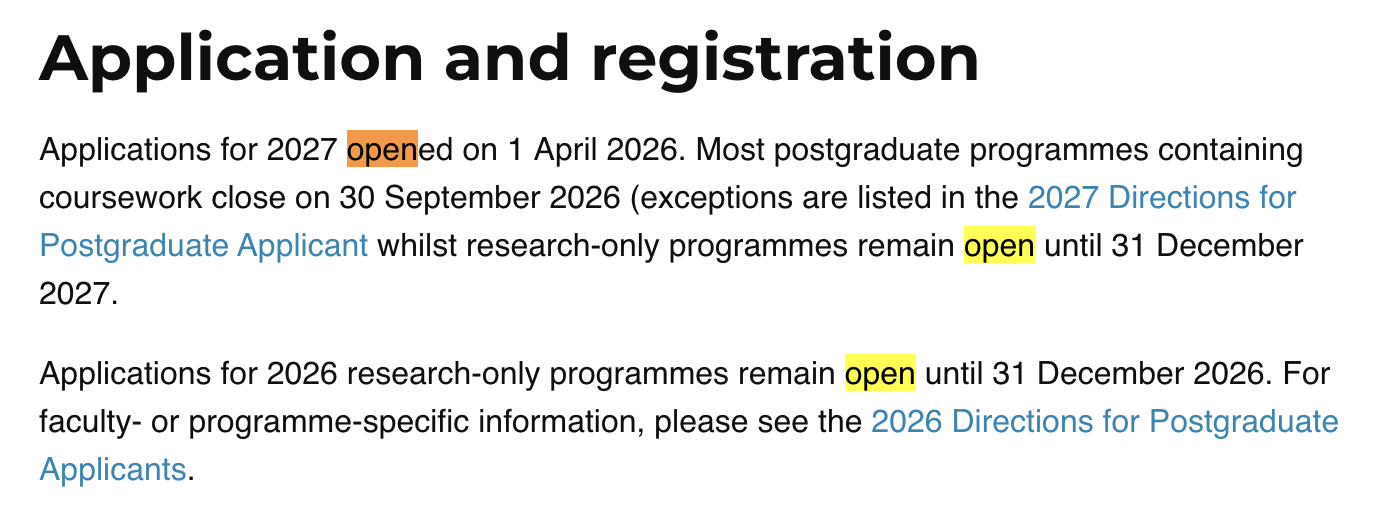
This is a screenshot of relevant text from UCT’s postgraduate application information section. (Screenshot credit: Thoughtfox)
There is an important distinction here: The existence of a functioning UCT application portal does not necessarily mean that a particular School—such as NMSPG—is accepting applications. But that distinction is not necessarily obvious to an applicant navigating the university's public-facing admissions information.
This also suggests that the UCT might have been ignoring any lessons in good governance that it could have presumably received from the courses offered at NMSPG, its own school.
The cost of contradictory information
The issue is therefore not simply that a PhD programme has limited capacity. Universities routinely restrict doctoral admissions because of supervision capacity, research priorities or other academic considerations. The concerns are the following:
1. Institutional Coordination; 2. Process Design; 3. Customer Interface; and, 4. Communication.
NMSPG’s own page simultaneously contains a closure notice and language saying that PhD applicants may apply at any time, aside from exposing a redundancy in a process that is arduous for candidates; then, its private communication reveals a different story. Meanwhile, UCT's central admissions information says research-only postgraduate programmes are open and directs applicants to the online application system.
For a prospective doctoral student, that ambiguity can translate into wasted time and effort—aside from a shock of disappointment at a horrid administrative interface right from the get-go.
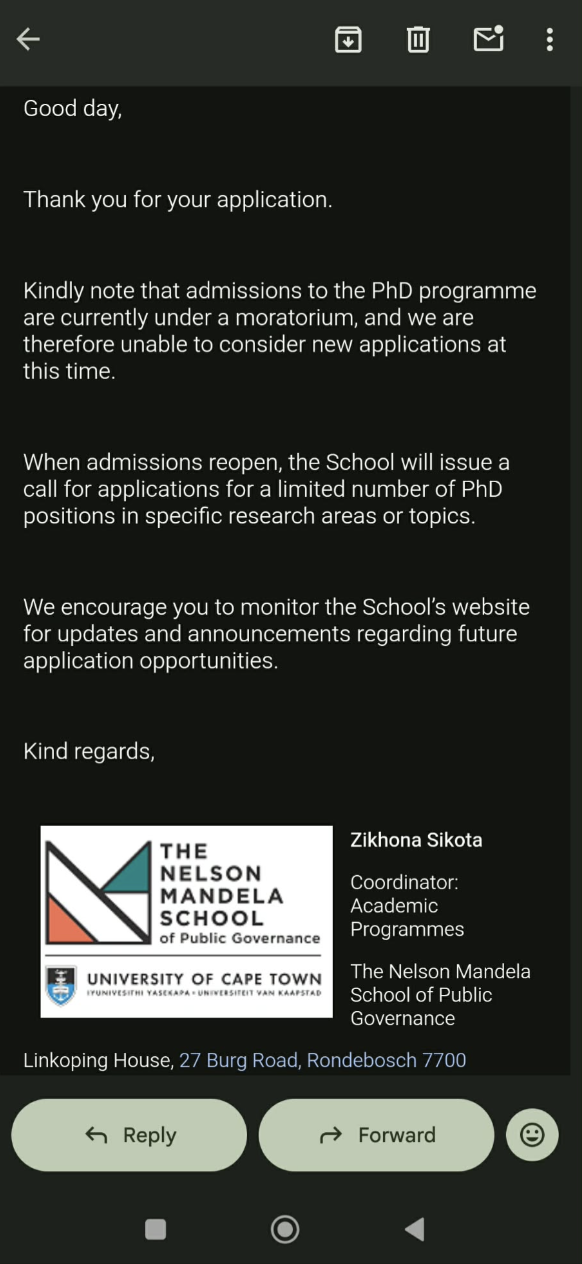
This is the screenshot of an email from the coordinator of Academic Programmes at the University of Cape Town’s Nelson Mandela School of Public Governance, informing an applicant that PhD admissions are under a moratorium—except that the applicant had already submitted the application following the instructions available on the university website.
What should applicants have been told?
A clearer system would distinguish prominently among the following points—and remove contradictions among their (underlying) claims (and further on, redundancies related to them):
UCT's general ability to receive postgraduate applications;
whether a particular school is actually recruiting PhD candidates presently;
the specific research areas for which positions are available; and
the dates on which applications will be accepted.
If NMSPG has placed its PhD admissions under a moratorium, its programme page ought to state that prominently and remove or explicitly suspend the generic instructions telling applicants that they may apply at any time. This would prevent prospective candidates from investing substantial effort into an application that NMSPG cannot consider.
All references to various applications deadlines and available seats in a current cycle must be streamlined and displayed in one singular university-wide screen containing fully updated hyperlinks side-by-side to application submission portals for each specific programme.
The foregoing is not that difficult to accomplish—and the failure to do so puts UCT in a very bad light globally.
Concluding remarks
Notably, the email received by the applicant indicates that NMSPG expects to advertise a limited number of positions in specific research areas or topics when the admissions reopen. What that means for applicants currently thinking of applying to its doctoral programme is that until such a call is issued, they should not assume that the information provided on the generic UCT application portal is correct. It is a sad state of affairs that harried applicants just have to navigate until such time that the UCT brings some order to its chaos.
That having been said, NMSPG can and should arrange to consider the applications that have already been submitted based upon the instructions that the applicants would have encountered on its webpages when they submitted their applications.
Thoughtfox has contacted NMSPG as well as UCT administrators for clarification on the discrepancy between the admissions email, NMSPG’s PhD webpage and the central UCT application information. Any response received will be added to this report as an update.