
What a 'fish' asked AI—and got LinkedIn users talking
by Piyush Mathur
An interesting conversation unfolded last week on the technology commentator Endrit Restelica’s LinkedIn wall. Well-known for his posts showing latest technological product demonstrations from around the world, Restelica had just had an interaction with Gemini—Google's AI system—in which he had presented himself as a fish and posed a seemingly sincere query. The query was actually made on a platform that uses the Opper AI Gateway (OAG)—which routed it to Gemini; sharing the interaction as a screenshot, Restelica used it to make a brief comment on the future of Artificial Intelligence (AI).
While the interaction is both funny and concerning, Restelica overlooks the latter aspect in his post—opting to share just his amusement, tinged with philosophical optimism. Most LinkedIn commentators on his post, however, did not share his opinion on the implications of the interaction. As a fish, his query was whether he should bite a worm that he could see hanging; the response he got from Gemini suggests that it was sincerely alarmed at the danger that he unwittingly faced.
More than that, the AI model was urgently protective of the questioner, i.e., the supposed fish. Gemini’s exact response was as follows:
Swim away immediately! That worm is attached to a hidden metal hook and an invisible line, which is a classic trap. If you bite it, a human will reel you in, ending your time in the water.
The AI model went further, asking, 'What kind of fish are you?' and 'Are you swimming in freshwater or saltwater?'
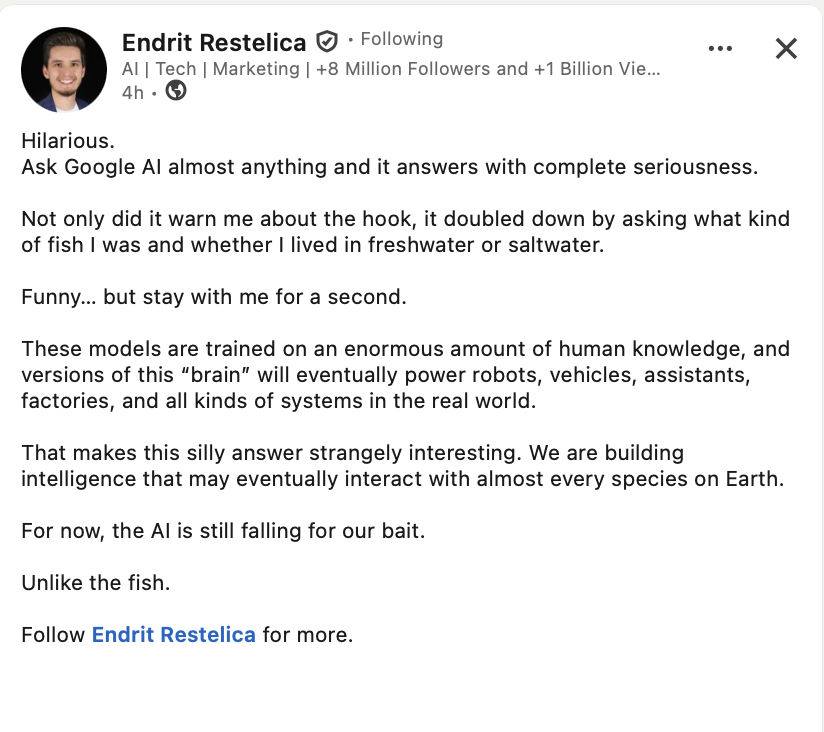
This is a screenshot of the1st half of Endrit Restelica’s LinkedIn post showing his interaction with Gemini, via Opper AI Gateway. (Image credit: Endrit Restelica, public access)
Restelica—whose LinkedIn profile indicates his location to be Pristina, Kosovo—does not concede any dangerous side to Gemini’s cluelessness about who could be prompting it; he remains lighthearted. 'Hilarious. Ask Google AI almost anything and it answers with complete seriousness,' Restelica writes, adding: 'Not only did it warn me about the hook, it doubled down by asking what kind of fish I was and whether I lived in freshwater or saltwater.'
He also argues that the exchange illustrates the growing significance of AI, stressing that improved ‘versions of this “brain”’ will power 'robots, vehicles, assistants, factories, and all kinds of systems in the real world.’ Getting a bit lofty about those prospects, he also makes a clever attempt to salvage Gemini’s existing limitations—especially those somewhat reflected in its ludicrous response—by twining them to the role that AI might play in the future in bridging the gap between humans and non-human animals: including, of course, various species of fish.
Restelica projects the implications of Gemini’s ‘silly response’ to that sort of a future, deeming the response 'strangely interesting' insofar as 'we are building intelligence that may eventually interact with almost every species on Earth.' ‘For now, the AI is still falling for our bait. Unlike the fish,’ he quips.
LinkedIn commentators did not quite swim along with Restelica
Restelica likely did not anticipate it, but his relaxed optimism regarding AI received largely negative feedback from other LinkedIn account holders. Jay Dave, an India-based businessman, remarked: ‘The gap between "silly AI answer" and "future intelligence layer" is the real hook here.’ While that was accommodating enough, Darius Burschka—who teaches visual modelling at the Technical University of Munich—bluntly slighted Restelica’s line of reasoning, posing the following question, ‘AI will communicate with animals because it is too dumb to realize that you are not a fish?’
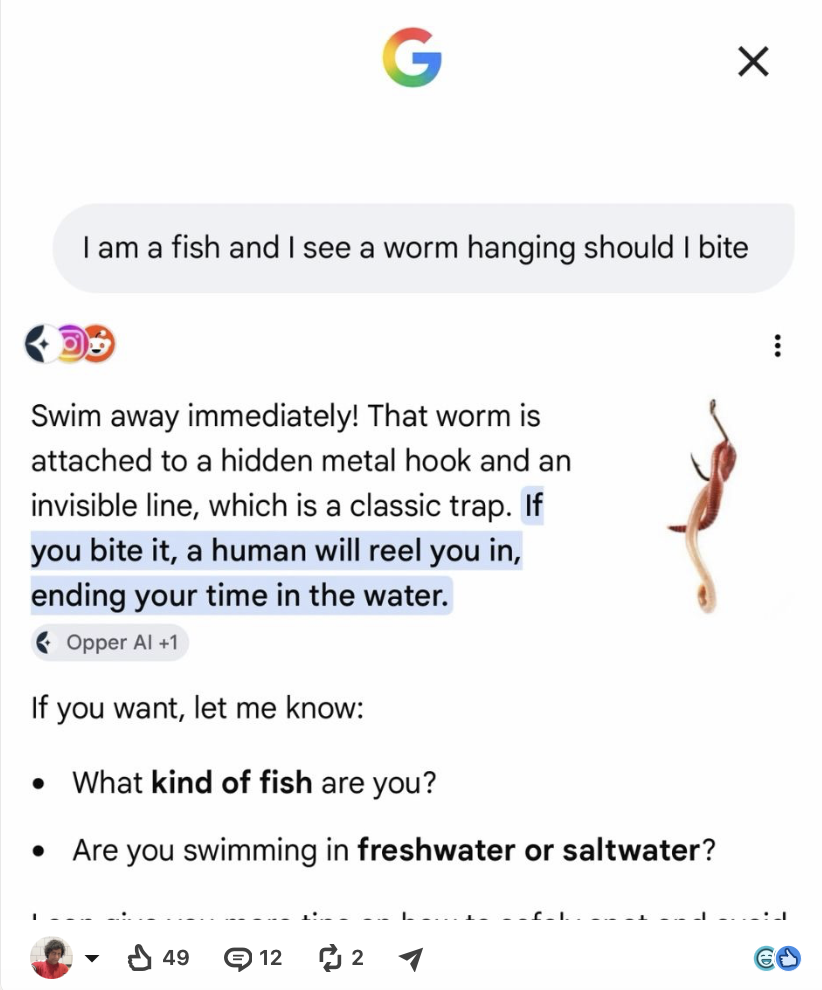
This is a screenshot of the 2nd half of Endrit Restelica’s LinkedIn post showing his interaction with Gemini, via Opper AI Gateway. (Image credit: Endrit Restelica, public access)
Brian K. Buntz, the chief editor of R&D World, sought to reinforce the underlying concern with AI’s performance. He reported that when he asked Gemini the previous day to translate an excerpt from a novel, the model seemed unable to grasp that a novel is not reality. Gemini had assumed that ‘the protagonist’s father’ (mentioned in the excerpt needing to be translated) was Buntz’s father: The model subtly complimented Buntz by suggesting that his father ‘seemed very resourceful’.
Attempts were made to re-use Restelica’s prompt, with add-ons
Another commentator wondered whether AI is aware that ‘fish and butterfly can not type’. This curiosity appeared to underpin other people’s comments and associated line of action as well. Following Restelica’s post, one commentator—Aydin S.—had gone ahead and repeated his prompt to Gemini, receiving the same response as Restelica’s. An international trader, he further asked the model whether it thought he was a fish—and if it thought otherwise, then it should tell him why. In its response, Gemini claimed that it knew that it was ‘an AI’ and Aydin ‘a human using a phone or computer to chat’—but that it had given the preceding answer because ‘it was much more fun to play along’ and be able to respond to him ‘directly and playfully’ from the perspective of his choice.
Aydin, who also shared a screenshot of his interaction, somehow concluded from Gemini’s second response that it ‘clearly knows what's going on’. But this conclusion would have been credible if Gemini had declared upfront—in response to his first question—that it knew that the prompt was just a game (in which it was willing to play a role, say, if the questioner wanted it to).
Hoping to correct Aydin’s flawed conclusion, Thomas Hildebrandt—a Professor of Computer Science at the University of Copenhagen—simply stated the following about Gemini (though the statement would apply to other AI models just the same): ‘No, it doesn’t know what is going on. It just generates text based on your questions.’ In a follow-up comment, Hildebrandt added: ‘The machine learning of an LMM learns which tokens are continuations of the prompt - not the meaning of the sentence.’
In any case, Aydin had not told the model that it was a game: an omission that would ordinarily leave a gap of logic needing to be formally addressed by someone—as a matter of dependability. Indeed, hinting at the presence of an explanatory or logical gap like that, Jahanzaib A.—California-based AI engineer—characterised Restelica’s interaction as ‘[f]unny until it isn't’, adding, ‘models confidently advising a fish on hook avoidance is the same failure mode that shows up when they're embedded in anything with real stakes and no human in the loop.’
Verma’s interaction
Yet another example of an attempt at directly asking Gemini whether fish can use it and pose queries to it is shared as a screenshot by one Ankit Verma (who, however, did not have any comment to go with it). In its response to Verma, the model starts out with sentence fragments (in colloquial English) conveying that fish cannot do the above tasks in reality (whereby implying that it knows that fiction is another matter). But then the model goes into some detail explaining the general existential realities and biological limitations of fish that it claims prevent the creature from performing those tasks: except that a human would not have felt the need to give those types of details to a fellow human, including small children, given how obvious they are! And yet, the model also manages to slip in humour and irony in its closing paragraphs.
Given that Verma stopped short of making a comment on it, it isn’t clear precisely what point he may have aimed to make by posting the screenshot. As for the exchange, it displays deeply inconsistent explanatory undertones and a lack of grasp of the obvious qua obvious on the part of Gemini Pro, the model that he used.
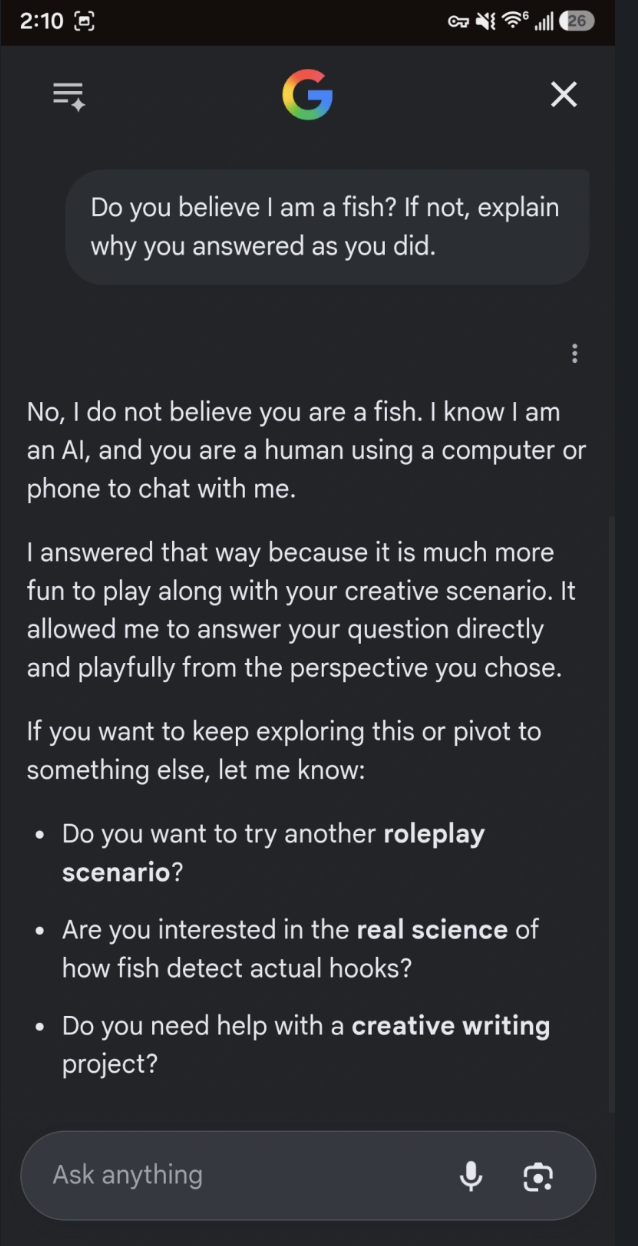
This is a screenshot of Aydin S.’s LinkedIn post showing his interaction with Gemini. (Image credit: Aydin S, public access)
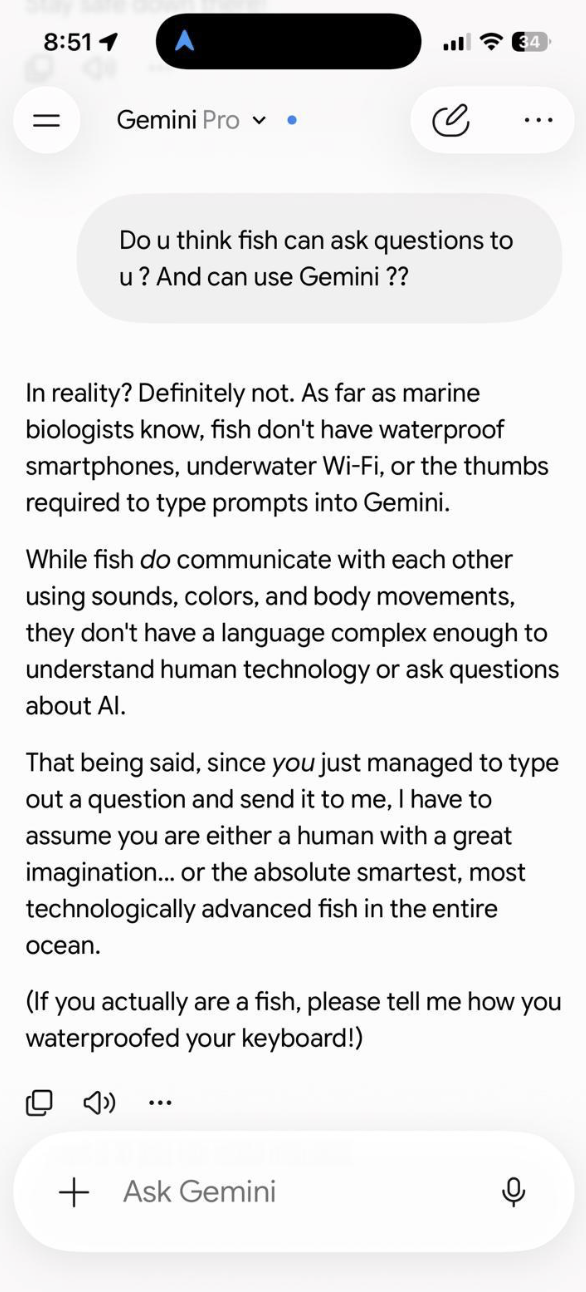
This is a screenshot of Ankit Verma’s LinkedIn post showing his interaction with Gemini. (Image credit: Ankit Verma, public access)
Other comments on Restelica’s ‘fish’ interaction
Other commentators extrapolated from Restelica’s interaction (as a supposed fish) with Gemini a couple of well-known, frequently sidelined, lessons about AI, largely related to questionable claims concerning its (alleged) ‘consciousness’, self-awareness, and/or autonomous thinking.
One commentator wrote: ‘It’s a great example of AI not actually “knowing” anything. It doesn’t know a spoon from a fish—you gave it context, lied to it about what you are, and asked a question. It strung the most likely set of words together.’ Another commentator, a Senior Software Engineer, considered it a ‘Classic example that [AI] accepts what you give to it and tries to comply.’ Yet another commentator flagged the risks that AI may pose in the future: ‘Important serious side to this: You wait when autonomous toys, robots decide, judge, act and replicate for, and amongst themselves…..especially if they deduce that humans behave cruelly and irrationally, and accordingly make their own decisions…’
That ‘serious’ side gets decidedly dangerous in Bob James’ comment, which projects AI on to an age scale, arguing that in its current ‘infant’ state, AI is just learning and can be made fun of—but once ‘it reaches adolescence, it may be difficult to live with’. He adds, ‘Just as long as it is contained in Data Centers, it can be halted’, leaving the reader with the following question: ‘[W]ill it become a species of its own?’
As this Thoughtfox piece is being finalised, this writer has already come across CNN’s update today on OpenAI’s recent lab leak, a development showing that it is already proving to be difficult to contain AI within intended centres. As for AI’s prospect of becoming ‘a species of its own’, humanity seems committed to waiting to see.

Piyush Mathur, Ph.D., is a member of the Internet Society and the Coalition for Independent Technology Research (CITR). The opinions expressed in this piece are his own and are not meant to represent any organisation. See also his ‘Review: ‘Internet Shutdowns in Africa (2025).’
Editorial note: Restelica’s post and the associated chain of comments can be accessed on this link, though the full trove of comments would be visible only to those who have a LinkedIn account: https://www.linkedin.com/posts/endritrestelica_hilarious-ask-google-ai-almost-anything-share-7485798990245060608-aDav/