
India’s Kotak Mahindra Bank’s workplace toxicity called out by exiting employee; the sector itself is crying for a revamp
by Dr. Piyush Mathur
In a widely shared LinkedIn post dated July 20, 2025, former employee Ridhi Sood alleges mismanagement and a toxic culture at Kotak Mahindra Bank, echoing growing concerns about systemic issues in India's banking sector.
Sood’s account details her brief but harrowing stint at the bank, marked by intimidation and neglect from its Human Resources (HR) department. Responding to online queries regarding why she exited her role without a backup, she notes that Kodak failed to be a place where she could foresee building a career.
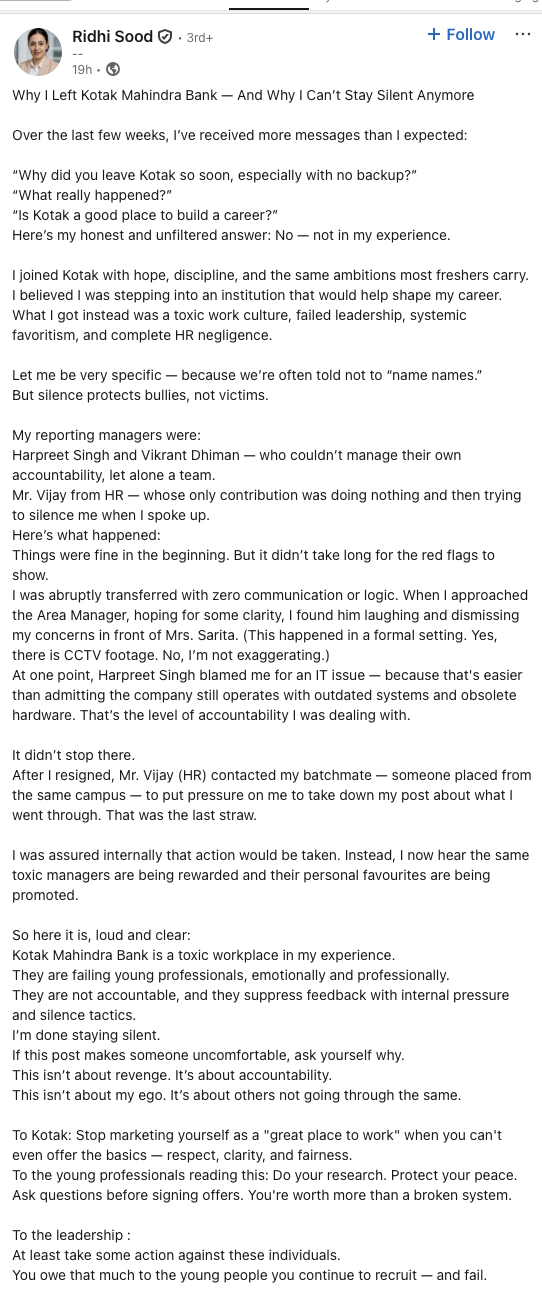
Ridhi Sood's LinkedIn post (dated July 20, 2025) blaming Kotak Mahindra Bank's toxic culture for her resignation.
Sood accuses her managers—Harpreet Singh and Vikrant Dhiman—of lacking accountability and professionalism, singling out an HR representative, Mr. Vijay, for trying to suppress her complaints rather than address them.
Her post recounts her abrupt and unreasonable transfer, and a humiliating dismissal of her related concerns in the presence of another person by her Area Manager.
Mr. Vijay, she points out, even tried to manipulate her through peer pressure following her resignation and her post about that.
But Sood also claims, somewhat contradictorily, that she was told that ‘action would be taken’ on her complaint (except that nothing was actually done anyway). Meanwhile, she came to know that the ‘toxic’ higher-ups involved in her case were being ‘rewarded’, with ‘their personal favourites…being promoted.’
Toxic work culture in India’s banking sector
Sood’s accusations align with occasional journalistic reports and other social media posts—including audio and/or visual footages—highlighting India’s persistent toxic workplace culture, including in the banking and finance sector.
Two well-known cases last year involved social-media leaks of online meetings in which bosses from Bandhan Bank and Canara Bank could be witnessed ridiculing and bullying their underlings. In 2023, there was a similar leak on Reddit showing Kolkatta’s Pushpal Roy, the regional head of HDFC bank at the time, loudly abusing his underlings, in Bangla, in a video meeting. (That video post has scores of comments that are informative in and of themselves.)
Previously, in 2022, an industry-wide reputation survey of 12 banks conducted over the course of the 12 months by Eminence, a Mumbai-based research firm, ended up with ‘a poor score’ of 16.2 as ‘the overall reputation score of the banking industry’. Noting ‘the need to focus on human-centric areas’, the survey report pointed out that ‘the score took a negative hit through Customer Experience and Workplace Character drivers.’
In November last year, a detailed personal testimony severely criticising the work culture at ICIC bank was posted on Reddit—except that the feedback to it dismissed its exclusivity to that bank (Meaning: Terrible work culture pervades basically all of India’s banks.)
While a 2017 academic study did conclude that public-sector bank employees of India had significantly more positive perceptions of their banks’ ‘work culture, job performance’ and subjective well-being ('SWB’) ‘than the employees of private sector banks’, there appears to be a lack of follow-up studies comparing the public and private banks along those lines.
Indian banks’ mismanaged work floors surely affect the employees’ psychological profiles. Via a ‘cross-sectional survey’ conducted through March-May 2022 of ‘282 bank employees’ of Kerala’s Kollam district, academicians Guruprasad Vinod and Srikant Ambatipudi had discovered ‘moderate to high levels of burnout…in 232 participants (82.2%)’, with ‘74 participants (26.2%)’ reporting ‘mild to extremely severe levels of stress.’ Their findings were published in August 2024 in the peer-reviewed Annals of Occupational and Environmental Medicine.
Suppression, not resolution; a call for accountability
Sood alleges that after she resigned, HR contacted her college batch-mate to persuade her to remove her LinkedIn post. ‘That was the last straw’, she writes, before declaring the institution ‘a toxic workplace’ that rewards managers who mistreat junior staff.
She emphasizes that her intent is not revenge but accountability—and concludes with a direct message to Kotak: ‘Stop marketing yourself as a “great place to work” when you can’t even offer the basics — respect, clarity, and fairness.’
With corporate India's global ambitions on the rise, stories like Sood’s can be seen as a warning that brand reputation cannot outrun bad internal culture.
Interestingly, only a day after Sood’s post, Madras Courier carried an opinion piece titled ‘Burnout, suicides & systemic failures: The silent crisis in India’s public sector banks’. In it, Kurian Mathew noted, without citing his exact source, that India’s public banks had seen more than 500 suicides over the past decade, ‘according to union estimates.’ Even if one ignores that statistic—which was also cited in 2024 in other journalistic and sectoral reports (see this, this, and this) on Indian banks’ appalling conditions—the road ahead for Sood and, for that matter, all Indian banks’ employees as well as customers (who remain on the final receiving end of all this negativity) remains nothing short of treacherous.
At the time of this report’s publication, Sood’s LinkedIn post had received over 7000 emoji reactions and 425 comments; it had been shared 86 times within the LinkedIn network.

Dr. Piyush Mathur edits Thoughtfox.
See also ‘Is the world primed for a new model of global banking?’ and ‘In Delhi, Union Bank of India manager issues apology…’